Skip to content
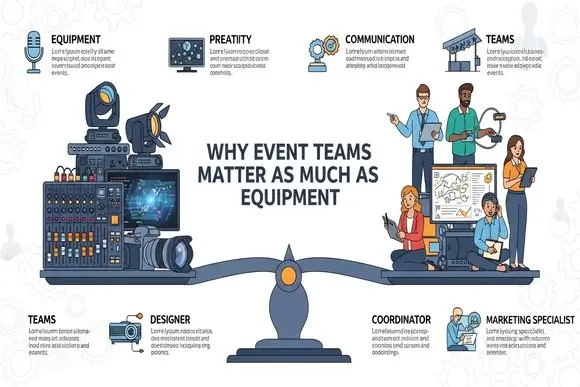
Equipment gives you the potential for a great event. The team behind it is what turns that potential into reality. They plan it, operate it, fix it when something goes wrong, and make sure the whole experience lands the way it was meant to.
Think about the last corporate event you attended that really impressed you.
Was it the LED screen that got you? The microphone quality? The lighting rig above the stage?
Probably not. What you most likely remember is how the whole thing felt. It ran smoothly. The sound was clear. The timing was spot on. Nothing went wrong, or if it did, you never noticed.
That feeling is not the equipment talking. That is the team behind it.
At EMS Events, we have been delivering corporate events in London for over 25 years. We have supported more than 20,000 events and worked with over 7,500 clients. And one thing has never changed: the quality of the people running the event is what the audience actually experiences, not the equipment list.
In this blog, you’ll learn why your event crew matters just as much as the gear and what to look for when you are choosing a production partner in London.
1. The best av kit still needs someone WHO really knows how to use it
Modern event technology is seriously powerful. We are talking 4K LED video walls, digital mixing desks, line-array PA systems, and hybrid streaming setups that broadcast your event to remote audiences in real time.
But none of it is plug-and-play. Not in a real venue. Not with tricky room acoustics, tight sightlines, and a presenter who changed their slides at 8 am on the morning of the event.
A skilled AV technician does far more than press play. They:
- Balance the audio for the specific shape and size of your room, because no two venues sound the same.
- Calibrate the visuals so your content looks crisp on screen, whatever format it is in.
- Set up lighting that suits the mood of your event, whether that is a focused conference or a high-energy product launch.
- Run a full sound check before a single delegate walks through the door, not a quick test, a proper check of every microphone and speaker position in the room.
- Spot technical problems before they become actual problems.
That kind of expertise comes from doing this hundreds of times, across hundreds of different venues. It cannot be switched on by reading a manual, and it cannot be replaced with better equipment.
2. When something goes wrong, a good crew fixes it before you notice
Here is something every experienced event producer knows: something will always go slightly off-plan. It might be tiny. It might be something only the crew spots. But something will shift.
The question is not whether things will go wrong. It is whether your production team will handle it so smoothly that the audience never knows.
A microphone cuts out mid-speech, a spare is already in hand. A laptop fails to connect to the screen; there is a backup playback option already staged. A speaker runs for fifteen minutes, the production manager is already adjusting the run-of-show and communicating the change to every crew member.
This is what is often called invisible problem-solving. And it is one of the clearest signs of an experienced corporate event production team.
EMS Events operates a 24-hour technical support line outside of office hours, because events do not respect business hours. Our Southwark warehouse is minutes from London’s major venues, meaning if something genuinely needs replacing on the day, we can be back on site fast. That is not luck. That is planning.
3. Great crews do not just set up the event, they shape the experience
There is a real difference between a company that drops off equipment and a company that produces your event.
Dropping off equipment means: here is the gear, good luck. Producing your event means that we understand what you are trying to achieve, and we are going to use the technology to help you get there.
In practice, that looks like:
- Thinking about your audience first. Where will they sit? What will they see? What needs to be on screen for the message to really land?
- Setting the room to match the tone. The way a space is laid out tells people what kind of event this is before anyone has spoken.
- Lighting that works for you. Not just lights in the ceiling, but lighting that creates the right atmosphere and makes your speakers look confident on stage.
- A clear run-of-show. A detailed plan that every crew member understands, so transitions are smooth and nothing is guesswork.
- Content support. Advice on slide formats, screen ratios, font sizes, and video files, so what goes on screen actually looks good when it gets there.
This strategic thinking is especially important for high-stakes events like product launches, conferences, AGMs, and hybrid events, where the production itself says something about your organisation.
4. Your event crew is part of your brand, whether you realise it or not
The people running your event are visible to your guests. They are in the room, setting up, briefing speakers, managing the space. And people notice.
A technician who greets your keynote speaker calmly, walks them through their slides, and clearly knows the setup inside out? That signals to everyone watching that this organisation takes its events seriously.
A crew that looks rushed, uncertain, or stressed? That does the opposite.
For client-facing events in particular, the production team is an extension of your service. If the event feels polished, guests associate that quality with you. If it feels rough, they associate that with you, too.
Professional event crews are briefed, prepared, and they understand that how they show up reflects directly on your brand, not just on the production company they work for.
5. The right team protects your investment and reduces your risk
Corporate events are a significant investment. Venue hire, catering, speaker fees, delegate travel, production costs, it adds up quickly. And the cost of something going wrong is not just financial. It is reputational.
A professional production team reduces risk at every stage:
- Before the event: they ask the right questions early, spot problems before they become expensive, and plan the technical setup around your specific venue, content, and audience.
- In the morning, they show up on time, every time. There is no scenario where a key technician does not appear.
- During the event, they monitor everything live, audio levels, video feeds, streaming stability, timing, and adjust quietly in the background.
- When plans change, they adapt without drama. Last-minute schedule changes, late speakers, or unexpected hybrid attendees do not derail the event because the team is ready for them.
EMS Events manages all of this in-house. From AV hire and stage set design to web streaming, simultaneous interpretation, and event branding, one team, one plan, one chain of accountability. When everything is in-house, there are no gaps between contractors. And gaps are where events go wrong.
6. Hybrid events make the human side even more important
If you are running a hybrid event, with some people in the room, some joining remotely, the complexity increases significantly.
You are managing two audiences at once. Two experiences that both need to feel seamless. Two sets of technical demands are running in parallel.
More equipment helps. But more equipment alone will not fix it. You need a team that understands how to blend the in-room and remote experience, how to make remote viewers feel included rather than like an afterthought, how to manage content cues across both formats, and how to keep the event energy consistent from the front row to the laptop screen in another city.
Equipment vs. People: how they work together
This is not one or the other. You need both. Here is how the two sides of a great event complement each other:
| Element | Equipment, the ‘what.’ | People, the ‘how.’ |
|---|---|---|
| Core job | Provides technical capability: sound, vision, light, connectivity. | Plans, operates, adapts, and optimises how that capability is used. |
| When things go wrong | Can fail or underperform in an unfamiliar space. | Anticipates failure, has a backup plan, and solves issues before the audience notices. |
| What the audience gets | Raw output: a signal, an image, a light source. | A coherent, purposeful experience shaped around your event objectives. |
| What they remember | Nothing, good equipment becomes invisible. | Everything: the flow, the atmosphere, the clarity, the confidence in the room. |
| Long-term value | Depreciates and is replaced over time. | Builds knowledge, relationships, and trust that improve with every event. |
The equipment is on the floor. The people set the ceiling.
What clients say after a well-run event
After a great corporate event, guests rarely say: ‘That was a technically impressive line-array PA system.’
What they actually say is:
- ‘Everything ran so smoothly.’
- ‘The room felt really polished.’
- ‘The message came across clearly.’
- ‘It felt like they had thought of everything.’
- ‘I didn’t notice anything go wrong.’
That last one is the most telling. You do not notice a great event crew. You just experienced a great event. The absence of any visible problems is the surest sign of a professional team doing its job properly.
What to look for when choosing an event production company in London
When you are comparing production partners, the equipment spec matters. But it is not the right place to start. Here are the questions worth asking first:
- Do they have experience with your event type? A team that has run 50 conferences has learned things a newcomer simply cannot replicate. Ask for specific examples, not just client names.
- Who will be your project manager? Is it the same person who took your brief? Will they be on site on the day? A single point of contact from start to finish is a strong quality signal.
- How do they handle something going wrong? Ask them directly. The quality of that answer tells you a lot about how prepared they really are.
- Do they outsource their crew? In-house teams maintain consistent standards. Outsourced crews introduce coordination risk that can fall on you if things go sideways.
- Where are they based relative to your venue? For urgent support or last-minute changes, proximity is a real operational advantage. A Central London production company can respond in ways a distant one simply cannot.
To sum up
Great equipment and a great team are not competing priorities. You need both. But here is the honest truth: most professional event production companies in London can get you the equipment. The real difference is in the people who show up with it.
The team is what makes the event feel considered, not just set up. It is what protects your brand when things get unpredictable. And it is what your audience experiences, even when they have no idea who is responsible for it.
At EMS Events, we have over 30,000 pieces of equipment in our Central London warehouse. But what has kept clients coming back for 12, 15, even 25 years is not the equipment. It is the team that arrives with it, prepared, professional, and ready for anything.
Whether you have months to prepare or days, we would love to talk. Call us on 0207 820 9000 or get in touch here, we are ready when you are.
Faqs
Why do the people behind an event matter as much as the equipment?
Because equipment only provides the technical capability. The event team is what makes sure it is planned properly, set up correctly, and adapted in real time when things change. A skilled crew can resolve technical problems before the audience ever notices. Equipment on its own cannot do that.
Is high-end av equipment enough for a successful corporate event?
No. High-end equipment is a great starting point, but without experienced technicians and a confident project manager, even excellent gear can be set up badly, fail to suit the venue, or create more problems than it solves.
WHAT DOES A CORPORATE EVENT PRODUCTION TEAM ACTUALLY DO?
A production team manages the full technical delivery of your event, from initial brief and technical design through to setup, sound checks, on-the-day operation, and de-rig. They handle logistics, calibrate equipment for your specific venue, support your speakers, monitor everything during the event, and adapt when plans change.
How do I choose the right event production company in London?
Look for proven experience with your event type, a dedicated project manager model, in-house operations rather than outsourced crews, and a location close to your venue for fast support. Ask directly how they handle equipment failures and last-minute changes; the quality of that answer reveals how prepared they really are.
Does the location of an event production company matter?
Yes, significantly. For urgent situations, a same-day equipment swap, a last-minute change, or technical support outside of office hours, proximity to your venue is a real advantage. A production company based in Central London can respond in under an hour. One based hours away cannot.
What makes hybrid events harder to manage than standard in-room events?
Hybrid events require managing two audiences at once, in-room and remote, with different technical needs, different content cues, and different experience expectations. The coordination needed to blend both into one seamless experience goes well beyond what any individual piece of equipment can handle. It requires experienced operators making live decisions throughout.
Do I need a full event production company or just av equipment hire?
For small or simple events, equipment hire alone may work. But for most corporate events, conferences, client briefings, product launches, hybrid events, AGMs, working with a full production partner delivers significantly better results and far lower risk. The difference is not just the equipment. It is the planning, the expertise, and the accountability that come with it.