Skip to content
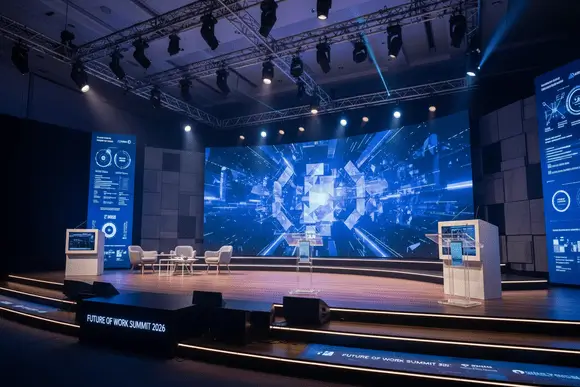
The year 2026 marks a defining moment in corporate stage design. What used to be a simple raised platform has now transformed into a multi-layered media environment where storytelling, branding, lighting, motion graphics, and audience engagement come together. Today, the stage isn’t just a place to speak. It’s the visual centrepiece that sets the tone, shapes the experience, and communicates the message before a single word is said.
Industry forecasts mirror this evolution. The global Event Stage Design Service Market is projected to grow from £2.95 billion ($3.93 billion)in 2025 to £4.65 billion ($6.2 billion)by 2035, driven by rising expectations for immersive visuals, hybrid-ready productions, sustainable builds, and more intelligent design workflows. Companies are no longer investing in staging as a necessity; they’re investing in it as a creative, technological, and strategic asset.
As event goals become more ambitious in 2026, stage design is moving toward deeper integration of LED architecture, dynamic lighting, modular structures, visual storytelling, and seamless physical-digital interaction.
What follows are the major trends reshaping how corporate event staging is planned, procured, and produced in 2026.
MARKET DYNAMICS: WHY STAGE INVESTMENT IS RISING IN 2026
Corporate stage design is becoming a priority investment as demand for in-person events rises, engagement becomes the core measure of success, and production expectations grow faster than budgets. The following factors highlight what’s driving this shift in 2026.
A. GLOBAL MARKET VALUATION AND GROWTH FORECASTS
The professional staging and design sector continues to show strong financial momentum. The Event Stage Design Service Market was valued at £2.82 billion ($3,760 million) in 2024 and is projected to grow to £2.95 billion ($3,930 million). This forms part of a long-term upward trend, with the market expected to reach £4.65 billion ($6.2 billion) by 2035, supported by a stable CAGR of approximately 4.6%.
This sustained growth reflects rising demand for high-quality production, immersive visual design, and advanced stage technologies that enhance audience engagement and deliver memorable, multi-sensory experiences.
Across the broader event landscape, including B2C, B2B, and trade show segments, spending sentiment is equally strong. 74% of event marketers expect budget increases in 2026, and 66% of organisations plan to host more events, marking a substantial rise compared to previous years.
B. ENGAGEMENT AS THE NEW ROI
Despite the expansion of virtual formats, the market strongly favours in-person attendance. Nearly 70% of corporate events in North America are expected to be held on-site in 2026, and 59% of event professionals prefer in-person formats over digital or hybrid alternatives. Notably, 78% of organisers say that in-person conferences remain their most impactful marketing channel.
In this environment, audience engagement is the defining success metric, cited by 49% of marketers as the number one factor in determining event success. Research shows attendees develop more positive perceptions of a brand after interacting with it at a live event.
The elements attendees find most memorable reinforce the importance of staging:
- Content quality (38%)
- Venue/environment (27%)
- Destination appeal (25%)
Together, these place the stage at the centre of the event experience: the physical and visual platform that shapes content delivery, mood, and brand storytelling.
With event costs rising, organisations are under increasing pressure to maximise ROI from their staging investments. As engagement drives outcomes, the stage is no longer viewed as a background element but as a core experience engine.
Additionally, events are now being leveraged as key sources of first-party data, shifting the value of staging toward features that support real-time audience interaction and data capture, from AI-driven personalisation to interactive surfaces. This moves stage procurement from a purely aesthetic decision to one based on measurable performance and data return.
C. BUDGET INFLATION VS. IMPACT EXPECTATION
Positive budget sentiment is counterbalanced by the realities of inflation. While 74% of marketers expect increased budgets, the industry faces a challenging financial gap: event costs are expected to rise by 12%, exceeding projected budget increases of around 11%.
This imbalance places significant pressure on planners to maintain high production quality while controlling costs. As a result, efficiency strategies are becoming essential, such as:
- Hosting events in second-tier cities to reduce venue and logistics expenses.
- Collaborating closely with staging and technology partners to implement integrated, cost-optimised solutions.
These strategies help organisations preserve immersive design quality and technical sophistication despite tightening margins and rising operational costs.
15+ DEFINING STAGE HIRE TRENDS FOR 2026
As corporate events evolve, stage hire is no longer just about platforms and lighting. In 2026, trends are driven by immersive experiences, hybrid-ready setups, advanced technology, and data-driven engagement. The following trends highlight the innovations and strategies shaping the modern corporate stage.
TREND 1: XR/AR/MR-READY STAGES (THE NEW STANDARD FOR IMMERSIVE CORPORATE STORYTELLING)
One of the most significant transformations in 2026 is the rapid adoption of Extended Reality (XR) into corporate stage environments. XR, AR overlays, VR elements, and Mixed Reality activations no longer belong exclusively to entertainment. They are now standard tools for:
- Product launches.
- Leadership keynotes.
- Investor summits.
- Brand storytelling.
- Training & simulation events.
WHY XR MATTERS
Audiences absorb information better when surrounded by immersive visuals. Instead of a static LED wall, XR turns the stage into a reactive, cinematic environment. Presenters can “walk through” data visualisations, stand inside a branded world, or demonstrate product features in 3D space.
WHAT MAKES AN XR-READY STAGE?
An XR-capable staging environment must include:
- Camera-tracking systems to match movement with digital environments.
- Uniform broadcast-grade lighting.
- Powerful media servers and real-time engines (for example, disguise and Unreal Engine).
- Fine-pitch LED walls with millisecond sync accuracy.
- Geometric calibration & radiometric compensation.
This setup requires specialised technicians, but the result is television studio quality inside a corporate venue.
TREND 2: AI-POWERED DESIGN, REAL-TIME VISUALS & AUTOMATED PRODUCTION WORKFLOWS
Artificial Intelligence is reshaping the staging workflow from planning to live execution.
A. AI IN PRE-PRODUCTION
Generative AI platforms allow designers to:
- Rapidly prototype stage concepts.
- Generate XR environments.
- Render multiple lighting and visual mood boards.
- Optimise layouts based on crowd density and camera positions.
What previously took days can now be done in hours.
B. AI DURING LIVE EVENTS
AI-driven projection mapping reacts to:
- Speaker movement.
- Audience applause.
- Sound cues.
- Emotional sentiment (via sensors).
This transforms the stage into a living visual organism.
C. AI IN POST-EVENT ANALYTICS
AI models analyse:
- Engagement heatmaps.
- Attention duration.
- Movement across interactive tiles.
- Emotional response in hybrid audiences.
This allows brands to justify staging investment with quantifiable insights.
TREND 3: INTERACTIVE LED FLOORS & RESPONSIVE STAGE SURFACES
The stage floor, often ignored for decades, has become one of the most innovative surfaces of 2026.
WHY IT MATTERS
Interactive LED floors create an unforgettable moment because the stage reacts directly to the audience or presenter. It may:
- Light up when someone steps on it.
- Trigger visuals during a keynote.
- Display branding animations.
- Enable gamified activities.
TECHNICAL FEATURES
High-end tiles now offer:
- 2T/m² load-bearing capacity.
- High elasticity for performance safety.
- Integrated sensors for motion and pressure.
- Real-time visual rendering.
THE ROI ADVANTAGE
Because LED floors track movement and dwell time, they generate first-party behavioural data, which is extremely valuable for corporate marketers.
TREND 4: DRONE-ASSISTED LIGHTING & KINETIC STAGE ENGINEERING
Although still emerging, kinetic staging is one of the fastest-growing premium trends.
WHAT’S CHANGING
Events increasingly feature:
- Drone light clusters.
- Automated scenic pieces.
- Floating LED panels.
- Moving ceiling rigs.
WHY THIS TREND IS GROWING
Kinetic design creates:
- High-impact transitions.
- Immersive entrances.
- Cinematic product reveals.
While costly, this innovation differentiates premium events and supports narrative-driven storytelling.
TREND 5: ULTRA-FINE-PITCH LED WALLS & 8K VISUAL FIDELITY
High-resolution LED walls (1.2mm–2.6mm pitch) remain one of the biggest investments in staging, and for good reason.
WHY FINE-PITCH LED IS ESSENTIAL
- XR environments require pixel accuracy.
- Hybrid audiences expect broadcast-level clarity.
- Corporate branding demands sharp visuals.
- Large-format rooms need high brightness.
HIDDEN COSTS (MOST CLIENTS DON’T KNOW ABOUT)
Beyond LED modules, costs increase due to:
- Heat-spreading copper layers.
- EMI shielding.
- Military-grade connectors.
- IP65/IP68 weatherproof ratings.
In 2026, buyers need to evaluate the total cost of ownership, not just per square foot pricing.
TREND 6: HYPER-PERSONALISATION & ADAPTIVE VISUAL JOURNEYS
2026 corporate audiences expect customised experiences, not generic presentations.
HOW PERSONALISATION APPEARS ON STAGE
- Tailored backgrounds based on audience segment.
- Real-time translation screens.
- Name-driven animations for VIPs.
- Personalised AR layers are visible on mobile devices.
AI enables content to shift dynamically, making each attendee feel individually addressed.
TREND 7: SUSTAINABILITY-FIRST STAGING (THE ESG IMPERATIVE)
Sustainability is no longer optional; it’s a purchasing requirement.
KEY SUSTAINABLE INNOVATIONS
- Modular aluminium framing made from 80% recycled material.
- LED lighting (90% lower power consumption).
- Reusable scenic elements.
- Biodegradable fabrics.
- Zero-waste scenic workflows.
Corporate ESG pressure ensures that sustainable stage providers will be the preferred vendors long-term.
TREND 8: HYBRID STAGE OPTIMISATION FOR DUAL AUDIENCES
Hybrid events require staging that performs equally well in-person and on camera.
CAMERA-OPTIMISED FEATURES
- No-shadow zones.
- Anti-flicker LED walls.
- Studio-level audio.
- Precision colour calibration.
AUDIENCE EXPERIENCE FEATURES
- Sightlines optimised for photography.
- Reduced light spill.
- Digital AR overlays for remote viewers.
The stage becomes the anchor point for two audiences simultaneously.
TREND 9: DATA-CENTRIC STAGE ENVIRONMENTS
Staging is now a data collection platform.
WHAT DATA IS CAPTURED?
- Heatmaps of audience movement.
- Interaction frequency.
- Touch and gesture analytics.
- Emotional response (via cameras or wearables).
- Hybrid dwell time metrics.
HOW COMPANIES USE THIS DATA
- Lead scoring.
- Personalisation.
- Predictive event design.
- ROI justification.
A stage that collects data is a stage that generates measurable business value.
TREND 10: INTEGRATED TECH STACKS & FULL-SERVICE PRODUCTION PARTNERS
Clients no longer want six different vendors. They want one partner who can deliver:
- Stage.
- AV.
- Lighting.
- XR.
- Streaming.
- Analytics.
- Set construction.
- On-site crew.
- Strategy & creative support.
This integration reduces logistical risk and improves creative cohesion.
TREND 11: MICRO-EVENTS & STAGE SCALABILITY
The 2026 corporate strategy includes:
- Smaller, frequent events.
- Regional activations.
- High-speed roadshows.
This requires staging that is:
- Fast to assemble.
- Easy to transport.
- Configurable across venue sizes.
- Cost-effective for repeated use.
Modularity is key for brands hosting dozens of smaller events annually.
TREND 12: WELLNESS, ACCESSIBILITY & NEUROINCLUSIVE STAGE DESIGN
Events are becoming more inclusive, both ethically and legally.
ACCESSIBILITY ENHANCEMENTS
- Accessibility-compliant ramps.
- Height-adjustable platforms.
- High-contrast visuals.
- Captioning & sign-language screens.
NEUROINCLUSIVE CONSIDERATIONS
- Reduced strobe effects.
- Avoiding sensory overload.
- Stabilised audio equalisation.
This ensures every attendee can engage fully and safely.
TREND 13: SECURITY, SAFETY, & OPERATIONAL RESILIENCE
As staging complexity increases, safety becomes a top priority.
CRITICAL REQUIREMENTS
- Redundant power systems.
- Backup streaming infrastructure.
- Certified rigging professionals.
- Fireproof scenic materials.
- Load-bearing engineering reports.
In 2026, risk management is a competitive advantage.
TREND 14: GENERATIVE VFX & MOTION-REACTIVE STAGE ENVIRONMENTS
GenAI has unlocked a new category of stage visuals.
Examples include:
- AI-generated landscapes.
- Audio-reactive particle effects.
- Real-time motion graphics linked to the presenter’s movement.
- Immersive brand worlds are created dynamically.
These tools allow even mid-budget events to produce studio-grade visuals.
TREND 15: SUPPLY CHAIN-RESILIENT PROCUREMENT
Global shipping delays and material shortages mean planners must rethink sourcing.
BEST PRACTICES
- Local and regional suppliers.
- Multi-vendor LED contracts.
- Early-stage procurement.
- Standardised modular components.
- Contingency inventory.
By designing for supply chain resilience, event organisers avoid chaotic last-minute failures.
TREND 16: ADVANCED PRICING MODELS IN STAGE HIRE
Staging vendors increasingly adopt pricing methods similar to SaaS and ticketing.
EMERGING MODELS
- Tiered staging packages.
- Bundled AV + stage + XR packages.
- Dynamic pricing for peak seasons.
- Subscription-style annual event support.
- Data analytics add-ons.
These models create more predictable budgeting for clients and scalable revenue for providers.
THE STAGE IS NOW A STRATEGIC BUSINESS ASSET
The corporate stage in 2026 is a broadcast studio, XR canvas, data engine, sustainability statement, and brand storytelling environment. Companies that embrace modularity, AI, XR, data capture, sustainability, and hybrid readiness will deliver events that are:
- More engaging.
- More measurable.
- More cost-efficient.
- More future-proof.
Your staging partner, whether EMS Events or another provider, must offer not just equipment, but strategy, technical capability, creative intelligence, and operational resilience.
When the stage evolves, the entire event experience evolves with it.