Skip to content
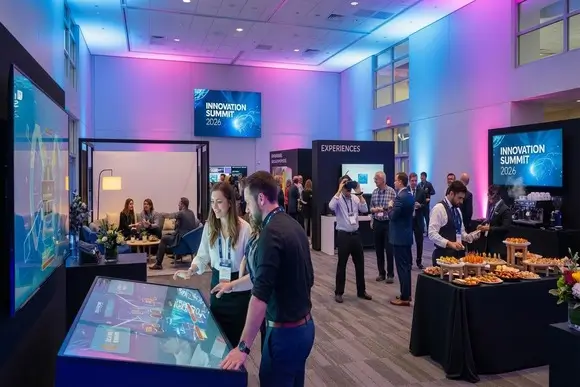
The most effective corporate events in 2026 are designed around audience engagement, not visual spectacle. Experience-led events involve participation, emotional connection, and measurable outcomes like engagement and retention, making them far more impactful than passive, presentation-based formats.
The old formula of “impressive room plus polished presentation” is not enough anymore. Modern corporate event experiences need to do more. They need to create attention, connection, and action.
That is why the most effective events in 2026 are not built around spectacle alone. They are built around the audience.
THE PROBLEM WITH SPECTACLE-FIRST CORPORATE EVENTS
There is a familiar pattern in a lot of corporate events. The room looks polished. The stage set is sleek. The lighting is dramatic. The schedule is packed. The catering is excellent. On the surface, everything feels successful.
Then, a week later, very little has changed.
The audience may have enjoyed the day, but they do not feel more connected. They do not remember many of the key points. They do not talk about the event in a meaningful way afterwards. In some cases, they leave with no stronger relationship to the business than when they arrived.
That is the weakness of spectacle-led event planning. It creates a short-term impression without always creating long-term value. A corporate event can look expensive and still underperform. In 2026, that matters more than ever because companies are putting event budgets under more pressure and asking sharper questions about what an event actually delivers. UK industry reporting shows the events sector is large and growing, but it is also operating in an environment shaped by rising costs, talent shortages, sustainability expectations, and changing attendee needs.
WHY CORPORATE EVENT EXPERIENCES MATTER MORE IN 2026?
Corporate events now carry more pressure than they used to. Businesses expect more from every event because time, attention, and budgets are all under greater scrutiny.
- HYBRID WORKING HAS CHANGED THE ROLE OF IN-PERSON EVENTS
Many teams no longer spend as much time together in the office. That means in-person events are no longer just “nice to have.” They are often one of the few moments when colleagues, clients, or stakeholders are physically together in the same room.
Because of that, the event has to do more than look impressive. It has to create a connection, strengthen culture, and make people feel part of something bigger.
- AUDIENCES ARE HARDER TO ENGAGE
People now arrive at events with shorter attention spans, packed inboxes, and constant digital distractions. A polished stage on its own is no longer enough to hold attention for hours.
If an event feels too passive, people check out mentally, even if they are still sitting in the room.
- BUDGETS NEED TO SHOW RESULTS
Event spend is being examined more carefully. Businesses want to know what the event actually achieved. Did it improve engagement? Did it build stronger client relationships? Did it help teams understand a new direction? Did it create momentum?
That is why experience-led events are becoming more valuable. They are easier to connect to meaningful outcomes.
SPECTACLE VS EXPERIENCE: WHAT IS THE REAL DIFFERENCE?
A spectacle is built to impress people from a distance. An experience is built to involve people from the inside.
That difference changes everything.
| Feature | The Spectacle | The Experience |
| Audience role | Passive observer | Active participant |
| Primary goal | Impressive visuals | Emotional connection |
| Technology | Loud and front-and-centre | Subtle and purposeful |
| What people remember | Forgotten within days | Stays with them for months |
| Success metric | Number of attendees | Depth of engagement |
| Outcome | Temporary excitement | Long-term loyalty and trust |
In a spectacle-led event, the audience mainly watches. In an experience-led event, the audience takes part. They respond, contribute, engage, ask questions, and connect with the content and with each other.
WHAT DOES A SPECTACLE LOOK LIKE?
A spectacle often includes:
- Big visuals.
- Dramatic staging.
- Polished presentations.
- One-way communication.
- A focus on appearance over interaction.
WHAT DOES AN EXPERIENCE LOOK LIKE?
An experience usually includes:
- Meaningful audience participation.
- Emotional connection.
- Useful conversations.
- Moments of reflection or contribution.
- A stronger sense of purpose.
The most effective corporate events are usually the ones where people leave feeling something, not just having seen something.
WHY SPECTACLES ARE LOSING THEIR POWER IN 2026?
This is not just an opinion. There are real reasons why the old way of doing corporate events is losing its grip.
- PEOPLE ARE HARDER TO IMPRESS AND EASIER TO LOSE
Did you know how much content your attendees see every single day? Ads, emails, reels, notifications, news, internal messages, and endless updates all compete for the same limited attention. That means a polished stage and a big LED screen are no longer enough on their own to hold a room.
If your event feels like another passive presentation, people mentally drift fast. Their phone is still in their pocket. Their inbox is still waiting. You have a short window to make people feel that being in the room is genuinely worth their full attention.
That is why audience engagement at events matters more than ever. The event has to earn attention, not just assume it.
- HYBRID WORK HAS CHANGED WHAT EVENTS NEED TO DO
Work has changed, and events have had to change with it. According to the CIPD, hybrid working remains common, with around three-quarters of employers having some form of hybrid provision in place. That means colleagues often see each other less, have fewer informal conversations, and can feel less connected to organisational purpose and culture.
That raises the stakes for in-person events. A corporate event is no longer just a nice day out of the office. In many organisations, it is one of the few real chances to rebuild connection, reinforce culture, and create a shared sense of direction.
A spectacle rarely does that well.
An experience can.
- VENUE COSTS ARE RISING, SO ROI SCRUTINY IS RISING TOO
Event budgets are also under more pressure now. A 2025 venue trend report found that 94.2% of venues surveyed said the cost of events is rising. That helps explain why finance teams and senior leaders are asking tougher questions about what events actually achieve.
If you can show that your event improved engagement, strengthened relationships, supported the pipeline, or helped teams align around a strategy, it becomes much easier to defend the investment. If all you can say is that the event looked good and people seemed to enjoy it, the budget conversation becomes much harder next time.
- PEOPLE INCREASINGLY VALUE EXPERIENCES THAT FEEL REAL
There is also a broader cultural shift at play. Eventbrite’s long-cited experience-economy research found that 72% wanted to spend more on experiences rather than physical things, and its newer event trend coverage continues to show strong demand for live experiences, especially among younger audiences.
That does not mean every corporate event needs to feel like a festival. It means people respond more strongly to events that feel participatory, human, and memorable than to events that simply look expensive.
WHY EXPERIENCE-LED EVENTS PERFORM BETTER?
Experience-led events work better because they help people connect with the message in a more active and emotional way.
When people are involved, they are more likely to pay attention, remember key messages, and act on what they hear. That makes the event more valuable for both the audience and the organisation.
THE FIVE PILLARS OF THE BEST CORPORATE EVENT EXPERIENCES
So what does an experience-first corporate event look like in practice? These are the five things that separate events people remember from events people forget.
1. START WITH A FEELING, NOT A FORMAT
Most event planning starts in the wrong place. People open a spreadsheet and start filling in logistics, venue, date, catering, and AV. But the most important question is not any of those things.
The most important question is: how do you want people to feel when they leave?
Proud of what the team has built? Excited about where the company is going? More connected to their colleagues? Clear on the strategy for the year ahead? Energised? Motivated? Grateful?
Whatever it is, name it. Write it down. Put it at the top of your brief. Everything else should flow from that answer. The venue should serve the feeling. The agenda should serve the feeling. The tech should serve the feeling.
When an event has that kind of clarity, it shows. People feel it, even if they cannot explain why.
2. GIVE PEOPLE SOMETHING TO DO, NOT JUST WATCH
Human beings do not learn or connect through passive observation. We learn by doing things. We connect by sharing things. We remember things that required us to be present and involved.
The best experiential corporate events build in meaningful moments of participation, not forced team-building activities, but genuine opportunities for people to contribute. Workshops where they solve real problems. Sessions where their input shapes the outcome. Conversations that are structured enough to be productive but open enough to feel real.
Examples of Meaningful Participation
- Live polling that influences the discussion.
- Small-group workshops.
- Q&A sessions that feel real, not rushed.
- Breakout conversations with a clear purpose.
- Collaborative sessions where attendees shape an outcome.
- Structured networking that feels useful.
When people are doing something, they are present. When they are just watching something, they are not.
3. MAKE THE TECHNOLOGY WORK FOR THE ROOM, NOT AGAINST IT
Technology is one of the most powerful tools in modern event production and one of the easiest to get wrong. The best tech at any event is the tech you do not notice.
It is the spatial audio that makes every seat in the room feel like the best seat. It is the LED video wall that supports the speaker without competing with them.
And it is the hybrid streaming setup that makes remote attendees feel like they are in the room.
We switched one of our recent ExCeL London seminars from a traditional high-intensity stage setup to a theatre-in-the-round format with immersive audio.
Participation in the Q&A session increased by 40%. Not because the tech was flashier, but because it removed the psychological distance between the speaker and the audience.
That is the difference between technology as spectacle and technology as production that serves the experience.
4. TELL A STORY WITH A BEGINNING, MIDDLE, AND END
The best events do not feel like random agenda items placed side by side. They feel like a journey.
A good corporate event should have a beginning, a middle, and an end. A strong event journey usually includes:
- A CLEAR OPENING
This helps frame the purpose of the day and tells people why the event matters.
- A MEANINGFUL MIDDLE
This is where discussion, ideas, insight, and engagement build momentum.
- A MEMORABLE CLOSE
This leaves people with clarity, emotion, and a sense of direction.
When an event has a strong narrative flow, it becomes easier for attendees to stay focused and remember the key moments.
5. DEFINE WHAT SUCCESS LOOKS LIKE, BEFORE THE DAY
A full room does not automatically mean the event was successful.
Attendance is only one metric. What matters more is what happened because people attended.
Better Ways to Measure Event Success
- Employee engagement feedback.
- Audience participation levels.
- Post-event sentiment.
- Client relationship strength.
- Follow-up actions.
- Team alignment.
- Brand perception.
- Pipeline influence for B2B events.
If you can answer that question clearly before the event, you can design toward it, and you can measure it afterward. That is how you prove ROI. That is how you get the budget approved next year. And that is how you get better with every event you run.
QUICK EXAMPLE: THE ANNUAL COMPANY CONFERENCE
- SPECTACLE VERSION
700 employees in a hotel ballroom. Three hours of leadership presentations. A year-in-review video. Lunch. An after-dinner speaker. Drinks. People leave having consumed the event, but with no clear sense of what it was for.
- EXPERIENCE VERSION
The same event becomes more interactive and purposeful. Teams take part in workshops. Leadership responds to live questions. Departments contribute ideas. The day is designed around one key business challenge. The close of the event celebrates shared thinking and clear next steps.
Same audience. Similar budget. Completely different impact. People leave feeling heard and with a genuine sense that the day mattered.
HOW EMS EVENTS APPROACHES EXPERIENCE-FIRST EVENT PRODUCTION?
We do not start conversations with kit lists. We start with questions.
Questions We Ask Before Planning Production
- What should attendees feel by the end?
- What should they remember a week later?
- What is the business trying to achieve?
- How should the audience engage with the content?
- What kind of room setup will support that goal?
- How can the event work better for both in-person and remote attendees?
Once we understand the answers to those questions, everything else follows. Our event production team works backward from the intended experience and forward through the logistics, technology, and design choices that will get you there.
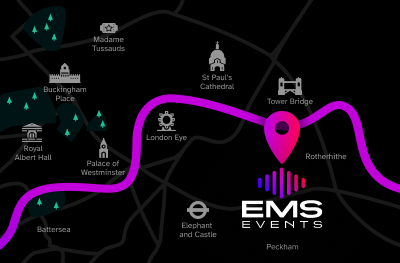
We operate from an 18,000 sq ft warehouse near Tower Bridge, with a large in-house stock of AV equipment, LED panels, staging, and hybrid production technology. That means fast setup, last-minute flexibility, and no nasty surprises on the day.
| What Our Clients Say“EMS Events transformed what could have been a standard annual conference into something our team is still talking about six months later. The difference was in how the whole day was designed, not just in the production values, but in the intention behind every moment.” Head of People & Culture, UK Financial Services Firm |
THE BEST EVENTS ARE THE ONES PEOPLE FEEL
Corporate events are not cheap. They take time, money, and a huge amount of effort from a lot of people. That investment deserves to actually work.
And the events that work, the ones that people talk about the following week, that shift culture, that deepen relationships, that generate real commercial results, are almost always the ones that were designed around people, not production value.
The spectacle gets the first few seconds of wow. The experience gets months of impact.
That is what we build at EMS Events. Whether you’re planning a conference, a product launch, an away day, or a client event, we bring the production expertise and strategic thinking to make it land properly.
So, if you are ready to plan a corporate event that people will actually remember, we would love to help. Ping us at 📞 0207 820 9000 or send an email to us at [email protected]. You can also visit us at Unit 16, Ruby Street, Southwark, London, SE15 1LR.
FAQs
WHAT MAKES A CORPORATE EVENT EXPERIENTIAL?
An experiential corporate event is designed around a specific emotional or behavioural outcome, not just a schedule of presentations. It builds in active participation, gives attendees a sense of agency, and creates moments they genuinely feel part of. The technology, production, staging, and content all work together toward one clear goal.
HOW DO I MEASURE THE ROI OF AN EXPERIENCE-FIRST CORPORATE EVENT?
Start by defining success before the event, not after it. Pre- and post-event employee engagement surveys, client Net Promoter Score (eNPS), pipeline tracking for B2B events, and qualitative feedback interviews are all solid tools. The key is choosing your metric based on the specific outcome you were aiming for. If you wanted to improve cross-team collaboration, measure that. If you wanted to deepen client relationships, track retention.
WHAT TYPES OF COMPANIES BENEFIT MOST FROM EXPERIENCE-LED EVENTS?
All of them, but especially those navigating change (mergers, new strategy, rapid growth), organisations with distributed or hybrid teams who rarely connect in person, businesses with high-value client relationships that need regular nurturing, and companies with a strong culture or employer brand they want to reinforce. In short: if your event needs to move people, not just gather them, experiential design is the answer.
HOW FAR AHEAD SHOULD I START PLANNING?
For mid-sized corporate events, we recommend starting at least three to four months before the date. For large-scale experiences, six months or more gives you the time to think, design, and book the best venues and suppliers. The earlier we can get involved, the more we can shape the experience, not just the logistics.
WHAT IS THE DIFFERENCE BETWEEN A CORPORATE EVENT AND EXPERIENTIAL MARKETING?
They are closely related but not the same thing. Corporate events are gatherings with a business purpose, such as conferences, away days, product launches, and client events. Experiential marketing uses immersive, participation-led events to build brand connection with consumers or business audiences. Both benefit hugely from the same principles: active involvement, emotional design, and a clear intended outcome.