Skip to content
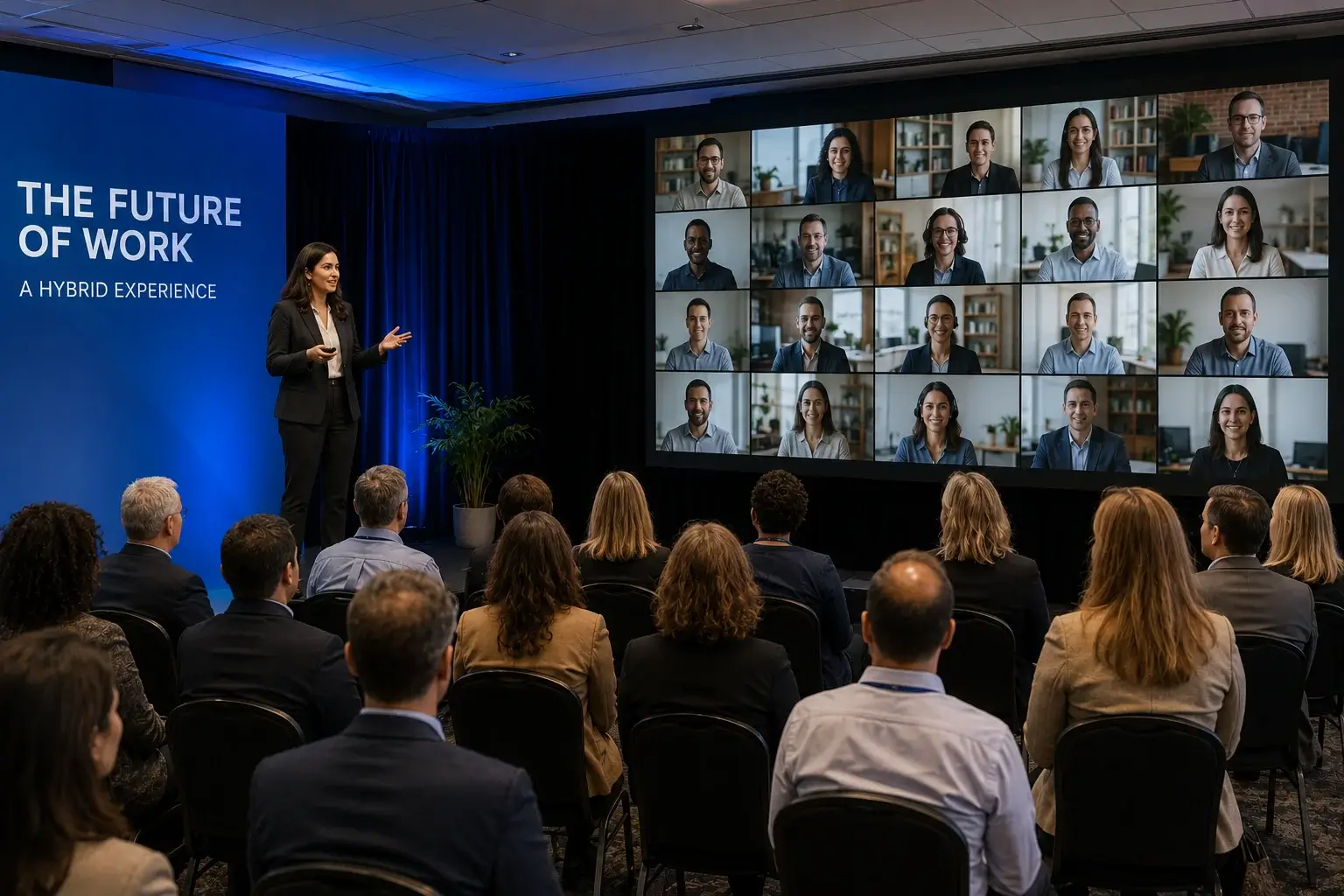
Hybrid events still combine an in-person audience and an online audience at the same time. What has changed is the standard.
A few years ago, hybrid often meant putting a camera at the back of the room and sending out a link. That is not enough now. A modern hybrid event needs two clear audience journeys, stronger AV, better streaming, smarter moderation, and a plan for what happens after the live moment ends. Event teams are now under more pressure to prove value, widen access, and turn live content into measurable results.
Cvent says 88% of marketers planned to invest in event technology in 2025, while 41% said they struggled to measure ROI and create competitive events in 2024. PCMA’s 2025 meetings market survey also found that 34% of organisers now stream part of their in-person events in real time, 21% offer asynchronous digital access, and 44% are fully in person. In other words, hybrid events are important, but they are not automatic. They have to earn their place.
If you still produce hybrid events like a room event with a stream attached, the online audience will feel forgotten, and the live audience will not get the best version either.
What a hybrid event really means now
A hybrid event is not just a live event with a stream attached. It is an event designed for two groups of people at once: the people in the room and the people joining remotely.
That sounds simple, but it changes almost every production decision.
The in-person audience feels the energy of the venue, the timing of the show, the conversations during breaks, and the atmosphere that comes with being there in person. The online audience gets none of that for free. They only get what the production gives them: the sound, the picture, the pacing, the graphics, the moderation, the interaction, and the ease of joining.
That is why hybrid production has matured. It is no longer just about sending a feed out. It is about designing an experience that works properly in two places at once.
A good hybrid event makes both audiences feel expected. A weak hybrid event makes the online audience feel like an afterthought.
That is the real difference.
Why hybrid events feel different in 2026
Hybrid events have grown up because the market has grown up.
In the early rush into virtual and hybrid delivery, many teams were simply trying to keep events running. The question was, “Can we make this work online too?” That mindset made sense at the time, but it is not enough now.
Today, organisers are under more pressure to prove value, widen access, create useful content after the live moment, and show clearer returns to sponsors and stakeholders. Organisations have increased their focus on data and ROI-driven decision-making. That alone tells you how much the conversation has shifted.
At the same time, the live room still matters. Freeman’s 2025 Trust Report says live events continue to have a positive effect on how audiences think and feel about brands, and that impact is getting stronger. Hybrid has not replaced live events. It has become a way to extend their reach when the format is right.
So the real shift is this:
Hybrid is no longer a novelty format. It is now a strategic production choice.
The old way vs the grown-up way
A lot of hybrid events still fail for one reason: they are being produced with an old mindset.
Eight areas. One upgrade.
A lot of hybrid events still fail for one reason — they’re being produced with an old mindset. Here’s what the upgrade looks like, eight areas at a time.
| Area | ✕Old hybrid thinking | ✓Grown-up hybrid thinking |
|---|---|---|
| 01Strategy | Add a stream to the live event. | Build one event plan with two audience journeys. |
| 02Audience | Remote viewers watch. | Remote viewers take part. |
| 03AV | Basic capture. | Deliberate camera, audio, graphics, and streaming design. |
| 04Venue choice | Nice room first. | Room plus technical suitability. |
| 05Speakers | Talk only to the room. | Present to the room and the lens. |
| 06Content | One session format for all. | Sessions shaped for both in-room and online attention. |
| 07Measurement | Attendance and basic delivery. | Reach, engagement, replay value, sponsor value, and ROI. |
| 08After the event | Recording is a bonus. | The content library is part of the plan. |
That is what “grown-up” really means in hybrid production. It means the digital audience is not treated as secondary. It means the production plan is built around both experiences from the start.
The number one rule of modern hybrid production
You are not planning one event with a live stream.
You are planning two audience experiences that share one core event.
That is the rule that changes everything.
The people in the room care about arrival, comfort, sightlines, timing, networking, and atmosphere.
The people online care about sound, camera direction, screen clarity, interaction, smooth access, and whether they feel seen.
If you treat those audiences as if they need the same thing, one of them will always get a weaker version.
Strong hybrid production starts by accepting that truth early.
The seven pillars of a grown-up hybrid event
These seven pillars are what separate a basic hybrid setup from a well-produced hybrid event. Get them right, and both your in-room and online audiences will feel properly considered from start to finish.
1. Start with the brief, not the platform
A lot of hybrid planning starts in the wrong place. Teams ask which platform they should use before they decide what the event is supposed to achieve.
That order causes problems.
The first question should be: what is this event meant to do?
Is it meant to build confidence with stakeholders? Generate leads? Support a product launch? Extend sponsor value? Create reusable content? Reach people who cannot travel? Align a wider internal audience?
Once that is clear, the production choices start to make sense. Without that clarity, even the best technology will feel random.
2. Decide whether hybrid is actually the right format
Not every event should be hybrid.
This is one of the clearest signs that the market has matured. The answer is no longer “make everything hybrid just in case.” The better answer is “choose the format that matches the job.”
A hybrid format usually makes sense when your audience is split by geography, travel budget, time, or access needs. It also makes sense when the content has replay value, when sponsors need more than physical footfall, or when the event should keep working after the room empties.
Hybrid usually makes less sense when the event is built almost entirely around private in-room relationships, when the online audience would only get a weak passive feed, or when the budget only covers a basic compromise.
A poor hybrid is often worse than a good in-person event and worse than a well-designed virtual event.
3. Choose the venue like a production environment
For a mature hybrid event, the venue is not just a room. It is a technical environment.
You need to know:
- Can cameras get clean angles without blocking the audience?
- Is there space for control and streaming positions?
- Can staging work for both the room and the feed?
- Is the internet genuinely strong?
- Can it be backed up properly?
- Will the house sound and lighting support streaming and recording as well as the in-person experience?
This is where many problems begin. A venue can look perfect on paper and still be the wrong environment for hybrid delivery.
4. Build av around the online experience too
Hybrid production is won or lost on the experience of the online audience.
The room can sometimes forgive a few rough edges. The online audience usually cannot. They notice poor sound, awkward camera work, unclear slides, sloppy switching, and flat pacing very quickly.
The biggest rule here is simple:
Sound first.
People will tolerate less-than-perfect visuals for longer than they will tolerate bad audio.
A grown-up hybrid event usually needs:
- an audio mix that works for remote listeners
- more than one camera angle
- clear show calling
- tested playback
- graphics and holding slides
- backup connectivity
- proper rehearsal
5. Design two audience journeys
Your in-person audience and your online audience do not travel through the same event in the same way.
The in-person journey includes the invitation, arrival, registration, signage, room energy, hospitality, transitions, and face-to-face networking.
The online journey includes the confirmation email, joining link, joining instructions, stream quality, moderation, chat, live questions, and what happens if someone drops off and comes back later.
Those journeys overlap, but they are not identical.
Strong hybrid events are designed deliberately. Weak ones assume the online audience will be satisfied with whatever the room gets.
They will not.
6. Train speakers and moderators for hybrid delivery
A speaker who is excellent in a room is not automatically excellent on camera. That is not a problem. It is simply a different skill.
In hybrid events, speakers need to know:
- where the camera is,
- how to keep answers tighter,
- when to address remote viewers directly,
- how to use slides that work on screen,
- and how to pause cleanly for moderation and remote questions.
Moderators matter just as much. A strong hybrid moderator helps the room and the remote audience feel connected. They bring online questions into the space naturally and stop the online side from becoming invisible.
7. Plan for engagement, content, and measurement after the room empties
One of the biggest signs that hybrid has matured is that the value no longer stops when the event ends.
Recorded sessions are not just leftovers. They are assets.
A strong hybrid event can create:
- Replay content for attendees
- clips for social and follow-up marketing
- sponsor visibility beyond the live day
- internal training material
- sales assets
- clearer engagement data for future planning
This is also where better measurement matters. Cvent’s 2025 event outlook highlights the continued pressure teams face around proving ROI, while PCMA’s latest survey shows how much attention the industry is now giving to data-led decision-making.
A hybrid event should not just “go live.” It should leave useful evidence behind.
Common mistakes that still ruin hybrid events
Even experienced teams still fall into the same traps.
Common mistakes that still ruin hybrid events
Even experienced teams still fall into the same traps. Here’s what goes wrong, why it hurts, and how to fix it.
| Mistake | Why it hurts | Better approach |
|---|---|---|
| 01Treating the stream as an add-on | Remote viewers feel second best. | Design for both audiences from day one. |
| 02Choosing a venue without checking connectivity or camera layout | The room works, but the stream struggles. | Assess the venue as a production environment. |
| 03Relying on one locked-off camera | Online viewers lose energy and context. | Build a simple but deliberate shot plan. |
| 04Sending room audio straight to the stream | Online sound feels weak or messy. | Create an audio plan for remote listeners. |
| 05Skipping proper rehearsal | Handovers and playback fail live. | Rehearse full transitions, not just microphones. |
| 06Letting online attendees become passive during breaks | They drift and do not return. | Use prompts, networking, or clear catch-up paths. |
| 07Measuring success only by attendance | You miss engagement and replay value. | Track watch time, interaction, drop-off, and follow-up. |
Your hybrid event production checklist 2026
Use this checklist before every hybrid event.
Two rooms.
One show.
A 12-month production arc, broken into 6 phases and 28 checks. Skip a phase, and the audience you forgot is the one you lose.
months
months
AV + camera + internet plan
Speakers briefed for stage
Sponsor stage presence
Reusable content flagged
Platform + stream + mod
Speakers briefed for camera
Sponsor digital presence
Replay + clip strategy
weeks
weeks
6–12 months before
- Define the event goal clearly.
- Decide if hybrid is the right format.
- Set separate success measures for in-room and online audiences.
- Choose your production partner early.
- Shortlist venues with technical viability in mind.
3–6 months before
- Map both audience journeys.
- Confirm platform, streaming, and moderation needs.
- Build an AV, camera, and internet plan.
- Brief speakers and moderators.
- Plan sponsor presence across both audiences.
- Decide what content you want to reuse after the event.
4–6 weeks before
- Finalise slides for screen readability.
- Build Q&A, poll, and interaction plan.
- Set up data tracking and reporting points.
- Confirm backup internet and contingency workflow.
- Prepare show graphics, holding slides, and cueing.
1–2 weeks before
- Run a proper technical rehearsal.
- Test playback, transitions, switching, and moderation.
- Check the joining instructions from the online audience’s point of view.
- Confirm camera lines, audio feeds, and stage blocking.
On the day
- Arrive early.
- Run a full system check.
- Keep one person focused on the remote audience experience.
- Monitor chat, Q&A, stream health, and timing continuously.
After the event
- Publish replay content quickly.
- Review engagement, drop-off, and attendance data.
- Share post-event reports with stakeholders and sponsors.
- Turn the strongest moments into clips, follow-up assets, and campaign content.
Why trust ems events on hybrid production
Hybrid production is not only about understanding the theory. It is about knowing what actually happens when staging, internet resilience, camera positions, speaker prep, show calling, graphics, and timing all have to work together in real life.
EMS Events is a London-based event production and AV specialist with over 25 years of experience and more than 20,000 supported corporate events across live, virtual, and hybrid environments. Our hybrid and virtual services offer end-to-end planning, technical delivery, management, streaming, content delivery, and technical support. That production background is exactly what hybrid events need.
As Harry White, Events Director at EMS Events, puts it: creating a memorable event takes technical know-how, meticulous preparation, and a touch of imagination, with every detail mattering from AV setup to production management. That is a strong summary of what hybrid now requires.
Conclusion
Hybrid events have grown up. That is good news, but it also raises the bar.
The format is no longer valuable simply because it exists. It has to be planned properly, produced properly, and measured properly. It has to serve both audiences well and justify its complexity. And it has to leave something useful behind once the live moment ends.
That means stronger briefs, better AV thinking, stronger speaker prep, better moderation, more replay value, and better reporting.
In short, hybrid production now has to think like a live event and a broadcast at the same time.
When that happens, the format stops feeling like a compromise. It starts feeling like a format that knows exactly what it is there to do.
Planning a hybrid event? Talk to EMS Events about production, streaming, and technical delivery from the start. Our web streaming and event production services are built around that joined-up support across live, virtual, and hybrid formats.
FAQs
Are hybrid events still worth it in 2026?
Yes, when a hybrid event solves a real access, reach, content, or sponsor problem. It is not worth doing by default. PCMA’s latest survey shows the market is mixed, not one-directional, and that is exactly why format choice matters more now.
What is the biggest mistake in hybrid event production?
Treating the online audience like passive spectators. That usually leads to weak sound, flat camera coverage, poor pacing, and low interaction. The remote audience needs a designed experience, not just access to the room feed.
What matters more in a hybrid event: picture or sound?
Sound. Strong visuals matter, but people leave quickly when they cannot hear clearly or comfortably. Audio quality is one of the fastest ways to build or lose trust in the stream.
Do hybrid events always cost more?
They usually require more planning and more technical structure than room-only events. The better question is whether the added complexity earns its place through better reach, stronger content value, wider access, or clearer reporting.
When should hybrid planning start?
Earlier than many teams think. The more important the event, the earlier the planning should begin. Hybrid rewards careful preparation and tends to expose rushed decisions very quickly.
What should success look like after a hybrid event?
Not just “the stream worked.” Success should include attendance, watch time, engagement, replay value, sponsor outcomes, and lessons that improve the next event.