Skip to content
TL;DR
Award ceremony production in London should be booked 4–6 months in advance during peak season (September to early December and March to May). Lead times collapse fast: by August, the best LED walls, line-array sound systems and senior crew for late-November Thursdays in Central London are routinely committed. Booking early secures equipment and rehearsal time; booking late forces compromises on kit, crew, and contingency cover.
If you have ever tried to source a 4mm LED video wall and a senior show caller for a Thursday evening in late November, you already know the answer to this. Awards season in London does not behave like the rest of the calendar.
At EMS Events, we have spent over 25 years delivering 20,000+ events and watching the same pattern repeat. Between mid-September and the first week of December, and again from early March to mid-May, demand for award show production in London compresses into a handful of preferred dates. Tuesdays and Thursdays at venues across Mayfair, the City, Park Lane, Canary Wharf, and the South Bank fill first. By early autumn, equipment availability tightens, crew diaries close, and prices for last-minute requests rise sharply.
The challenge is not just planning a great event. It is securing the right equipment, crew, and timelines before availability disappears.
This guide breaks down:
- When to book production.
- What equipment is hardest to secure?
- How to plan fallback options properly.
When to book an award ceremony production in London?
The honest answer is that the best dates and the best kit go early. There is no advantage in waiting, and there is a meaningful downside.
Recommended booking windows
For a Central London awards ceremony of 200–600 guests with a stage set, LED screens, lighting rig, and live sound:
Ideal
Workable
Tight
High risk
These are working windows, not marketing ones. They reflect what we actually see in our diary at EMS Events as bookings come in across the season.
Why does the compression happen?
Three things drive it. First, awards events cluster around dinner-friendly weekday evenings, so the supply-side pinch points are narrow. Second, the same weeks host conferences, product launches, and Christmas parties, so AV crews and trucks are split across multiple shows on the same nights. Third, top-end equipment, large-format LED, line-array PA, automated lighting fixtures, and comms systems exist in finite quantities across the London market, and once they are on hold, they are gone.
Equipment demand during awards season
Not everything tightens at the same rate. Knowing the order in which the kit gets committed helps planners prioritise their booking conversations.
What gets booked first?
Some equipment consistently sees the highest demand:
Large-format LED video walls in 2.6mm, 2.9mm, and 3.9mm pixel pitches are the standard for stage backdrops and IMAG. Demand has grown faster than London stockholdings.
Senior show callers and technical producers, experienced freelancers running awards shows, are a small pool, and they book up earliest.
Line-array sound systems suited to ballrooms with difficult acoustics (Park Lane and Mayfair hotel ballrooms in particular).
Automated lighting rigs with moving heads and intelligent fixtures for the ceremony look.
Camera packages and vision-mixed IMAG with multi-camera operators and a director.
Simultaneous interpretation booths and receivers for international award audiences.
Comms systems (radios, talkback) for larger crews.
Stage sets, basic conference PA, and small-format LED tend to hold availability later, but bespoke set builds need lead time of their own for design, fabrication, and load-in scheduling.
Why does demand spike?
Awards events rely heavily on:
- Visual impact.
- Live audience engagement.
- Broadcast-quality presentation.
This makes production more complex than standard conferences.
Real-world scenario
A corporate awards night in Canary Wharf required last-minute screen upgrades. Because booking was delayed, only smaller LED panels were available. The client had to redesign the stage layout days before the event.
What equipment do you need for an awards ceremony?
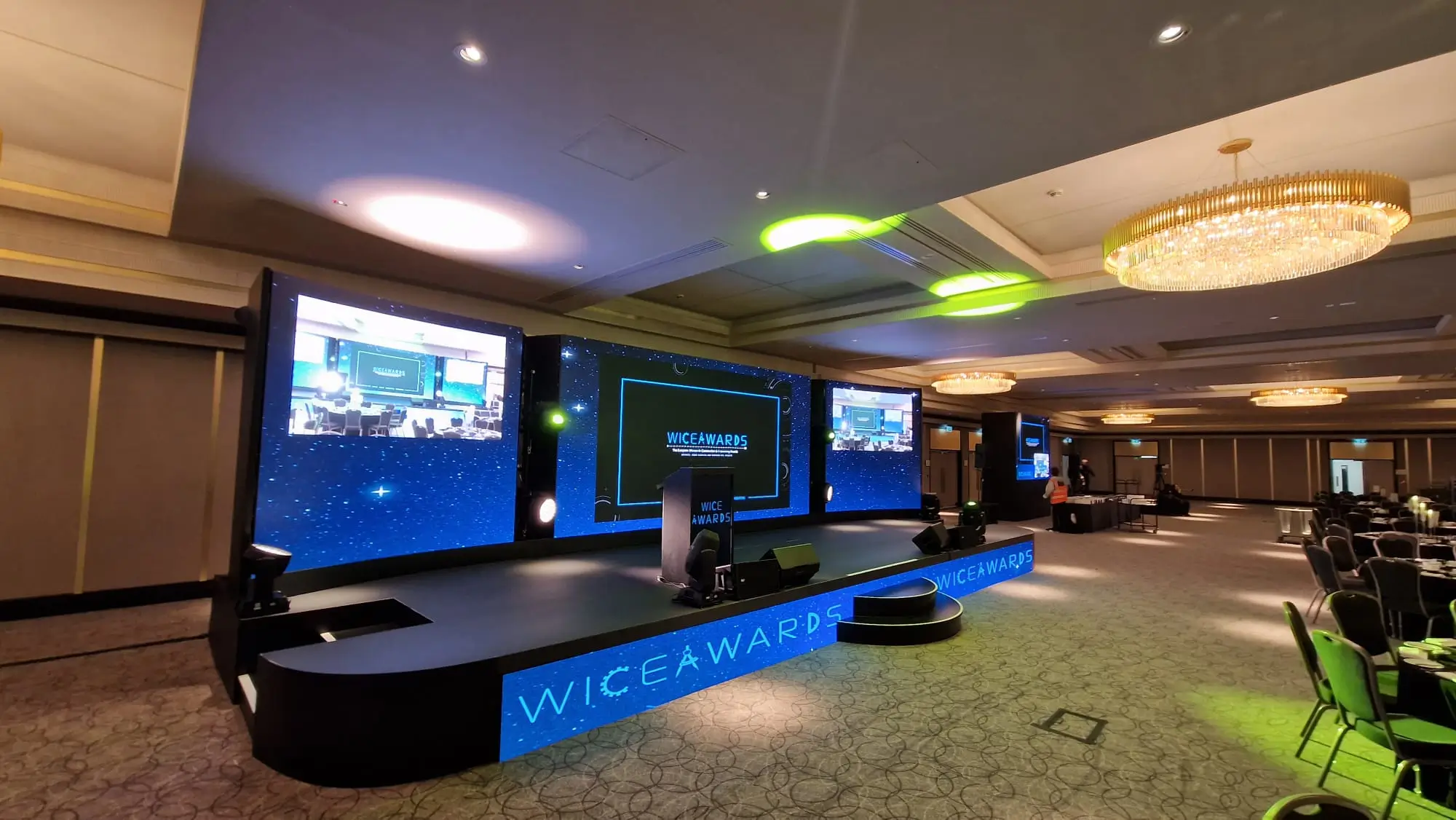
Award ceremony production requires a combination of staging, lighting, sound systems, LED screens, and control equipment. These elements support presentations, speeches, live performances, and audience engagement, ensuring the event runs smoothly and delivers a professional visual and audio experience.
Core production setup
- Stage design and build.
- LED screens for visuals and branding.
- PA system for clear sound coverage.
- Lighting for ambience and focus.
- Show control system (for cues and timing).
Additional considerations
- Live streaming or hybrid setup.
- Simultaneous interpretation (if an international audience).
- Red carpet lighting and photography zones.
Planning technical rehearsals and crew scheduling
Awards ceremonies are tightly scripted. Timing is everything. An award show includes:
- Walk-on music.
- Presenter cues.
- Winner announcements.
- Video playback.
Without rehearsals, even small delays can disrupt the flow.
Best practice
- Schedule a rehearsal at least 4-6 hours before the event.
- Confirm all cues with the show caller.
- Test audio, video, and lighting transitions.
Crew coordination
A professional setup includes:
- Audio engineers.
- Lighting technicians.
- Video operators.
- Stage managers.
At EMS Events, we assign a dedicated crew based on event scale, ensuring full control on-site.
London-specific logistics you must plan for
London venues often have strict rules:
- Limited load-in times.
- Noise restrictions.
- Power supply limitations.
Venues in Westminster and Central London can be particularly tight on access.
Transport and access
- Congestion zones affect delivery timing.
- Parking restrictions impact crew movement.
- Lift access limits equipment size.
These are factors many generic guides ignore.
Fallback plans: how to avoid last-minute disasters
Every live awards event carries risk. From technical failures to last-minute dropouts, the unexpected is part of the territory, and how well you’ve prepared for it determines whether the show goes on seamlessly or unravels in front of an audience.
Why contingency planning matters
Contingency planning is the part of awards production that is most often underdone. Most briefs we receive treat redundancy as an afterthought: ‘You’ll have backups, right?’ when it should be a structured part of the production design.
Essential fallback strategies
- Backup microphones ready on stage.
- Spare LED panels available.
- Redundant power supply or generator.
- Store duplicate show files separately.
Real example (A live failure, handled right)
A live failure, handled right
At a London awards event, a primary microphone failed during a keynote. Because a backup was already live, the transition was instant, and the audience never noticed.
Working with your production partner: practical steps
A few principles that consistently make awards productions go well, drawn from how we work with clients at EMS Events:
- Share the date the moment it is fixed, even before the brief is fully written. Holding equipment on a provisional basis is straightforward; finding it from cold in October is not.
- Walk the venue together. A site visit with your production lead surfaces issues with rigging points, sightlines, power, and load-in routes that no floor plan reveals.
- Agree on the rehearsal model in writing. Who is in the room, what is being run, who calls “hold,” and what the cut-off is for script changes.
- Define ownership of contingency. The production company runs the equipment fallback, while the client and venue own the show-stop decision. Both responsibilities need to be agreed upon in advance.
- Keep the show caller close to the script. Late changes to running order are the single most common cause of live awards errors.
If you are planning a ceremony for the next season and want to scope production properly, our team is happy to walk through the brief.
Plan Your London Awards Production With EMS Events
Award ceremony production in London is about timing, availability, and preparation.
The earlier you plan, the more control you have over:
- Equipment quality.
- Production design.
- Event delivery.
At EMS Events, our experience across thousands of London events has shown that the most successful awards nights are not just well-designed. They are well-prepared.
If you are scoping a ceremony for this season or next, we are happy to talk through dates, venues, contingency, and budget without a sales push.
FAQs
When should I book AV for an awards ceremony in London?
You should ideally book AV 4-6 months in advance for peak season in London, with 8-16 weeks being the minimum for simpler events.
What is the biggest risk in awards event production?
The biggest risk is last-minute equipment or crew shortages. This usually happens when planning starts too late.
Do I need backup equipment for a small awards event?
Yes. Even small events benefit from backup microphones and power solutions to prevent disruptions.