Skip to content
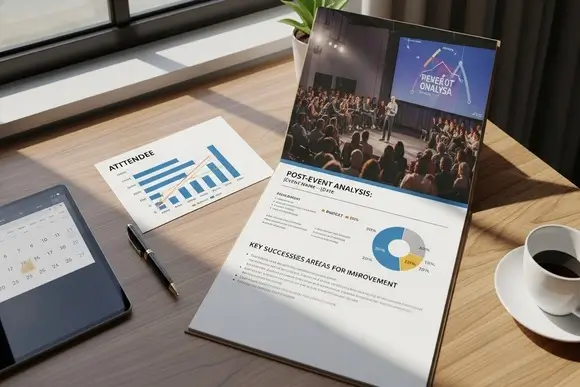
Post-event reporting is the structured process of collecting data, feedback, and technical insights after an event to measure whether it met its objectives. A proper post-event report covers attendance figures, audience feedback, technical performance, budget actuals, and ROI, giving event planners the evidence needed to justify spend, improve future events, and report confidently to stakeholders.
THE THREE WORDS THAT ARE QUIETLY DAMAGING YOUR EVENT’S MOMENTUM
“It went well.”
Three words. Zero data. And yet for years, this has been the default post-event report for thousands of corporate events across the UK.
Just recall your last event you ran. You hired the venue, briefed the AV team, managed the speakers, coordinated catering, and spent weeks, maybe months, in preparation. The day arrived. Things happened. People clapped and went home. And then someone senior asked how it went, and you said, ‘It went well.’
But did it? How do you actually know?
Did every delegate in the room hear clearly? Did the remote attendees on the hybrid stream stay engaged or quietly drop off after 20 minutes? Did the LED wall display your slides at full resolution, or were the colours slightly off? Was the event worth what it cost?
If your post-event process ends with ‘zero satisfaction’, you’re leaving enormous value on the table and making the next event harder to plan, justify, and improve.
This guide explains what modern post-event reporting looks like, why it matters for every type of event, and which metrics you should be tracking, including the technical and AV performance data that most teams still overlook.
WHAT IS POST-EVENT REPORTING?
Post-event reporting is the structured practice of gathering, analysing, and documenting measurable data and qualitative insights after an event has taken place. The goal is not to write a summary of what happened. The goal is to answer three core questions:
- Did the event achieve its objectives?
- Where did it perform well, and where did it fall short?
- What should change next time?
A report that answers these questions transforms your event from a one-off experience into a learning asset: something that makes every future event smarter, more efficient, and more impactful.
For events supported by professional AV and production teams, post-event reporting also includes a technical layer: audio performance, visual display quality, streaming reliability, and equipment logs. This is where working with an experienced event production partner like EMS Events makes a measurable difference.
WHY “IT WENT WELL” IS NO LONGER ENOUGH?
The events industry has changed significantly over the past decade. Events are bigger budget items. They face more scrutiny. And with hybrid and virtual formats now standard, there are more variables to track than ever before. You can directly Download Post Event Report Sample PDF for better understanding.
Here are the four reasons why informal reporting is no longer fit for purpose:
1. STAKEHOLDERS EXPECT EVIDENCE
Finance directors, boards, and senior leadership teams want to see that event spend delivers value. Informal feedback does not cut it. A report with clear data, attendance, satisfaction scores, and business outcomes makes that case with authority.
2. HYBRID EVENTS CREATED MORE VARIABLES
When events had only one audience (the people in the room), a quick visual check was often enough. With hybrid events now spanning live and remote audiences simultaneously, you need data to understand both experiences. An in-room delegate might have loved the event; a remote attendee may have dropped off 15 minutes in because the stream buffered.
3. REPEAT EVENTS NEED BENCHMARKS
If you run an annual conference, awards ceremony, or AGM, you need year-on-year data to see whether things are improving. Without documented benchmarks, every event starts from zero. With them, you can track trends, set targets, and demonstrate progress.
4. SUPPLIER PERFORMANCE MUST BE DOCUMENTED
If your AV setup had an issue, a microphone that cut out, a stream that dropped, or a display that flickered, that needs to be on record. Not to blame, but to improve. Your AV partner should be accountable, and a structured debrief process ensures that accountability is mutual.
WHAT A POST-EVENT REPORT SHOULD INCLUDE: A COMPLETE CHECKLIST
A thorough post-event report does not need to be a 50-page document. It needs to be structured, evidence-based, and actionable. Here are the seven core sections every report should contain:
1. EVENT OVERVIEW AND OBJECTIVES
Start with context: what the event was, who it was for, when and where it took place, and what it was designed to achieve. List the specific, pre-agreed objectives, whether that was lead generation, employee engagement, product awareness, or media coverage. Everything in the report should tie back to these objectives.
2. ATTENDANCE AND AUDIENCE DATA
Record your actual attendance figures against what was planned. For hybrid events, break this down between in-room and online attendees. Track session-by-session attendance if relevant, note peak moments, and log drop-off rates for virtual streams. This data reveals your actual reach and how engaged your audience really was.
3. TECHNICAL PERFORMANCE REVIEW
This section is too often missing from event reports, particularly for non-technical event planners who are not sure what to measure. At a minimum, a technical review should cover:
- Audio quality: Was the sound clear and consistent across all areas of the venue, including breakout rooms?
- Visual display performance: Did LED walls, projectors, and screens display content at full resolution and correct colour?
- Streaming reliability: What was the uptime and average stream quality for hybrid or virtual attendees?
- Equipment issues: Were any faults encountered, and how were they resolved?
- Crew performance: Were technical operators and production crew on time, professional, and responsive?
EMS Events provides technical debrief notes from every on-site crew deployment, giving clients a ready-made foundation for this section of their post-event report.
4. AUDIENCE FEEDBACK AND SATISFACTION SCORES
Distribute your feedback survey within 24 hours of the event, while memories are fresh. Track Net Promoter Score (NPS), session-level satisfaction ratings, speaker scores, and open-ended comments. Aggregate results and identify patterns, not just averages, but the outliers that reveal where the experience broke down.
5. BUDGET VS. ACTUALS
Document planned spend versus actual costs across every category: venue hire, AV production, catering, staffing, marketing, travel, and any ad-hoc purchases. This section protects your budget planning credibility and gives you an honest baseline for the next similar event.
6. ROI AND BUSINESS OUTCOMES
Link your results back to business objectives. This might mean leads generated from a product launch, media coverage secured from a press event, employee satisfaction uplift from an internal conference, or sales influenced by a client dinner. Choose metrics that reflect what the event was actually for, and be honest about what was and was not achieved.
7. LESSONS LEARNED AND RECOMMENDATIONS
This is the most valuable section, and the most commonly skipped. Write specific, actionable recommendations for next time. What would you change about the venue layout? The run-of-show? The AV setup? The delegate journey? A lessons learned section turns a single event into organisational knowledge, and makes every future event better than the last.
AV AND TECHNICAL METRICS: THE DATA MOST EVENT REPORTS ARE MISSING
For corporate events, conferences, product launches, award ceremonies, and hybrid meetings, AV and technical performance data is one of the most informative and underreported categories of post-event insight.
Here are the key technical metrics worth capturing after any professionally produced event:
- Sound pressure levels (SPL): Was audio coverage consistent across all audience zones, including at the back of large rooms?
- Stream uptime and quality score: For hybrid events, what percentage of the stream was delivered without interruption?
- Average online watch time: Did virtual attendees stay for the full event, or drop off during specific sessions?
- Display resolution and calibration: Were LED walls and screens running at the correct resolution with accurate colour reproduction?
- Equipment fault log: What equipment issues occurred, how quickly were they identified, and how were they resolved?
- Rig and de-rig timing: Were the build and breakdown completed within the agreed schedule?
EMS Events operates from a central London warehouse near Tower Bridge, enabling rapid equipment swaps and on-site technical support throughout the event day. Our crew logs are available post-event to support your technical debrief process.
HOW EMS EVENTS SUPPORTS BETTER POST-EVENT REPORTING?
EMS Events is a London-based AV hire and event production specialist with over 25 years of experience delivering events for corporate, hospitality, and institutional clients across London and the UK.
With a stock of more than 30,000 pieces of AV equipment and a team of experienced on-site technical operators, EMS Events works alongside event planners not just to deliver events, but to help clients understand how those events performed.
Our contribution to your post-event reporting process includes:
- Technical debrief notes from every EMS Events crew deployment.
- Streaming and webcasting performance data for hybrid and virtual events.
- Equipment fault logging and resolution records.
- Rig and de-rig schedule adherence documentation.
- Input into lessons learned and AV recommendations for future events.
For venue partners, EMS Events integrates directly into your venue’s AV offer, providing an on-site team, structured reporting as part of the service package, and ongoing technical consistency that benefits both your team and your clients.
TO PEN DOWN
Post-event reporting is not a nice-to-have. It is the difference between running events and improving them.
The next time someone asks you how your event went, do not say it went well. Say: attendance was up 12% on last year. Satisfaction scores averaged 8.4 out of 10. The hybrid stream delivered 94% uptime. We generated 47 qualified leads. And here is what we would do differently next time.
That is what modern post-event reporting looks like. That is what stakeholders need to hear. And that is the standard that the best event planners and the best event production partners are now working to meet.
EMS Events has supported hundreds of events across London and the UK, from intimate boardroom meetings to large-scale conferences and hybrid productions. Our team is experienced in delivering the technical insight that feeds into meaningful post-event reporting.
Contact EMS Events to discuss your next event and find out how our production and AV expertise can help you measure, not just deliver, event success.
FAQs
WHAT IS POST-EVENT REPORTING?
Post-event reporting is the structured process of collecting and documenting data, feedback, and insights after an event has taken place. A post-event report measures whether the event met its objectives, captures audience feedback, reviews technical performance, and documents budget actuals, giving event planners the evidence needed to improve future events and justify spend to stakeholders.
WHAT SHOULD BE INCLUDED IN A POST-EVENT REPORT?
A post-event report should include: an event overview and original objectives, attendance and audience data, a technical performance review (including AV and streaming), audience feedback and satisfaction scores, budget versus actual spend, ROI and business outcomes, and a lessons learned section with recommendations for next time.
HOW SOON AFTER AN EVENT SHOULD I COMPLETE A POST-EVENT REPORT?
You should begin compiling your post-event report within 24 to 48 hours of the event ending. Core data, attendance, technical logs, and budget actuals should be captured on the day or immediately after. Audience feedback surveys should be distributed within 24 hours while the experience is fresh. A completed report is typically ready within five to seven working days.
WHAT METRICS SHOULD I TRACK FOR HYBRID EVENT POST-EVENT REPORTING?
For hybrid events, your post-event report should track both in-room and online attendance figures, streaming uptime and quality scores, average virtual watch time, session drop-off rates, chat and Q&A engagement, and technical fault logs covering both the physical and digital experience. Your AV partner should be able to provide streaming performance data as part of the debrief.
HOW DO YOU MEASURE ROI FOR A CORPORATE EVENT?
Measuring ROI for a corporate event depends on the event’s purpose. Common ROI metrics include leads or pipeline generated, sales influenced, media coverage value, employee satisfaction or engagement scores, training outcomes, brand awareness uplift, and sponsorship return. The key is to establish your success metrics before the event, not after, so your post-event data is directly comparable against what you set out to achieve.
WHY IS TECHNICAL PERFORMANCE DATA IMPORTANT IN POST-EVENT REPORTING?
Technical performance data reveals whether the event delivered the intended experience for every attendee, including those who did not speak up. Poor audio at the back of the room, a hybrid stream that dropped, or display screens running at the wrong resolution can all silently reduce event impact without appearing in basic feedback forms. AV performance data captures these gaps and enables targeted improvements for future events.
CAN MY AV COMPANY CONTRIBUTE TO POST-EVENT REPORTING?
Yes, and they should. A professional AV and event production partner like EMS Events can provide technical performance data, on-site crew notes, equipment fault logs, streaming analytics, and rig/de-rig schedule records. This technical layer enriches your overall post-event report and ensures you have an accurate, complete picture of how the event was delivered from a production perspective.