Skip to content
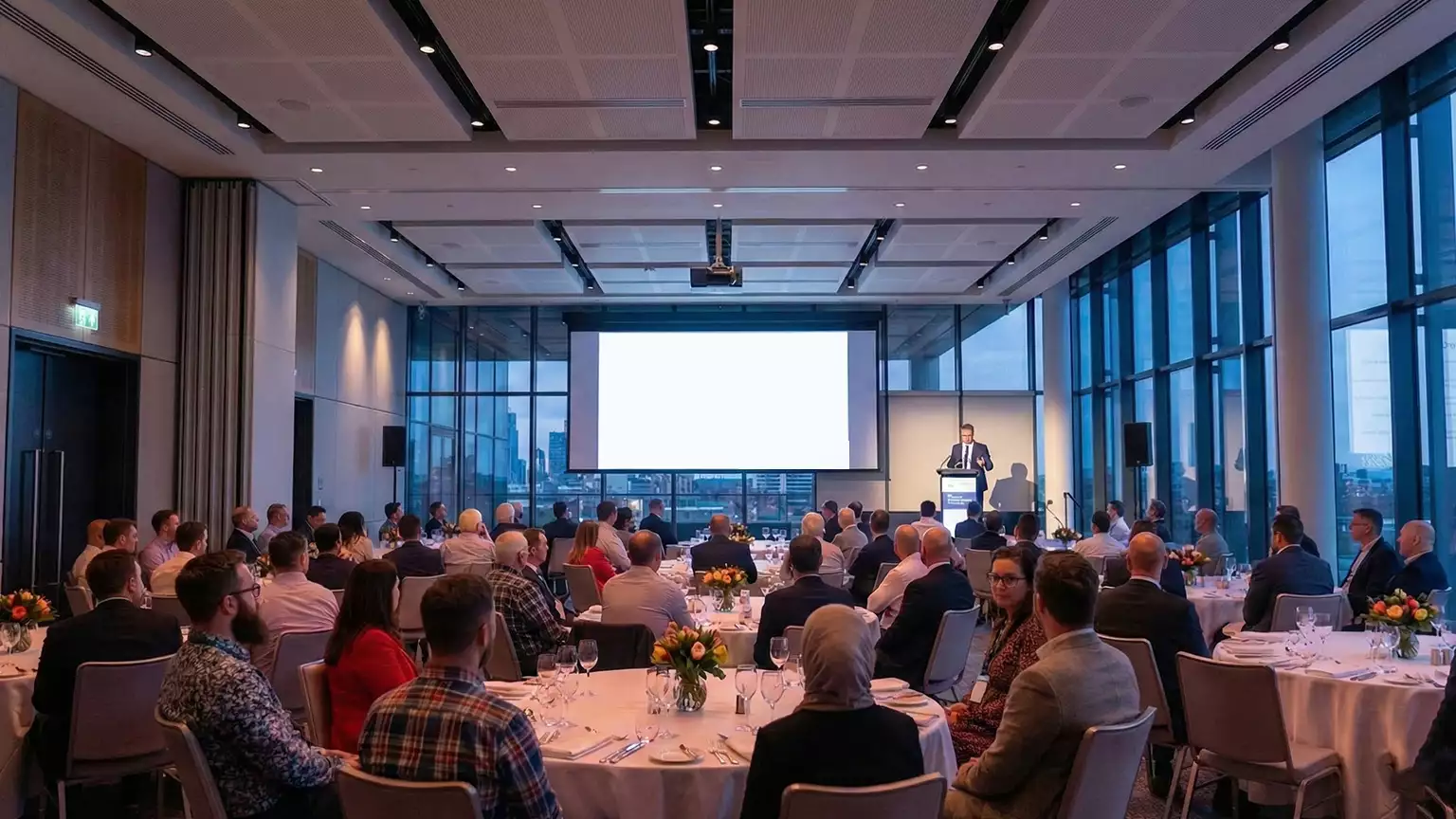
Speaker placement shapes how well people hear, see, and connect with your message. Get it right, and your event feels effortless. Get it wrong, and even the best speech can fall flat.
You can have the best keynote, the sharpest visuals, and the most confident speaker, but if the sound doesn’t carry or the stage feels distant, the message won’t land. That’s the quiet truth behind every great corporate event: where your speaker stands matters just as much as what they say.
Speaker placement is one of those details that hides in plain sight. Yet it shapes everything: how the audience listens, how they connect, and how they remember your brand long after they leave. A few metres forward can turn a flat presentation into a magnetic one. A poor angle can make even a brilliant speech sound like background noise.
So, let’s explore why speaker positioning is more than just a set-up choice. It’s a central part of a truly engaging corporate event.
WHAT DOES SPEAKER PLACEMENT ACTUALLY MEAN?
It’s not just where the sound system stands. It’s how the speaker’s position shapes connection, sound flow, and visual comfort.
When a presenter stands in the right spot, everyone can hear clearly, see naturally, and feel part of the moment. Poor placement breaks that flow, creating distraction instead of focus.
WHY DOES SPEAKER PLACEMENT DESERVE MORE ATTENTION?
Because a well-placed speaker keeps the room together physically and mentally.
Most planners focus on the visuals, the mic, and the stage lighting. Few stop to think exactly where the speaker should stand. But in corporate events, that detail is what decides how people listen, engage, and remember.
When a presenter stands too far back, the sound scatters and the energy drops. Too close, and the setup feels cramped or intrusive.
Finding the right balance between presence and comfort is part of what turns a speech into a real experience.
At EMS Events, we’ve learned this through years of setting up conferences and product launches. A shift in placement, just a few metres, can transform the atmosphere of a room.
KEY ELEMENTS OF SPEAKER PLACEMENT IN CORPORATE EVENT SUCCESS
Speaker placement is the bridge between message and memory. The right setup shapes how sound travels, how people connect, and how smoothly your event flows. Below are the eight core elements that determine how well your speaker placement strategy performs in any corporate setting.
HOW DOES SPEAKER PLACEMENT AFFECT VISIBILITY AND CONNECTION?
If people can’t see, they stop listening.
Imagine listening to a speaker you can barely see behind a screen or pillar. The message might be powerful, but you are disconnected before it even begins.
Good speaker placement keeps every attendee in the loop, with no blocked views and no awkward head tilts.
For large venues, elevation helps. For smaller set-ups, side-stage or centre-aisle positioning makes the interaction more natural.
It’s not about showing off the stage; it’s about keeping every person, from the first row to the back corner, part of the moment.
WHAT ROLE DOES PROXIMITY PLAY IN ENGAGEMENT?
Closeness builds trust.
The closer a speaker feels, physically and emotionally, the stronger the connection with the audience.
- Proximity matters: A centre-aisle or thrust stage helps close the gap. Movement adds energy: Speakers who move command attention without needing extra volume.
- Eye contact seals it: When people feel seen, they stay engaged.
We often design layouts where the speaker can walk freely across the stage or even down into the audience. It makes the moment feel less like a lecture and more like a conversation.
HOW DOES SOUND WORK WITH SPEAKER PLACEMENT?
Sound travels with space, not volume.
Sound behaves differently in every room; hard walls bounce it. Carpets absorb it. A speaker that’s too close to a wall can create an echo, while one placed too far out might leave ‘dead zones’ where the sound fades.
This is where professionals apply what’s called the “38% rule.” It’s a principle borrowed from acoustics:
“Place your listening or seating position about 38% of the way into the room (measured from the front wall) to reduce standing waves and uneven sound reflections.”
In corporate terms, that means positioning your audience and speakers so the sound waves travel evenly across the room, neither bouncing too much off the walls nor dying too soon. It’s especially helpful in rectangular venues or boardrooms.
When EMS Events sets up a space, we use this as a starting point. From there, we fine-tune based on the venue shape, ceiling height, and expected audience density. It’s science, but also experience; the kind that comes from hundreds of live setups.
HOW DO LIGHTING, CAMERAS AND SCREENS TIE INTO PLACEMENT?
Sound may reach ears, but lighting reaches eyes.
Modern corporate events often blend live and virtual elements. That means a speaker is not just addressing a room; they are also performing for a camera.
Placement must therefore work with lighting, angles, camera framing, and projection screens. Too much backlight, and faces disappear. Wrong camera line, and the livestream feels detached. Screens set too wide? The audience will split its focus.
When all three, sound, sight, and light, align, you get an immersive, balanced experience both in person and online.
DOES VENUE TYPE CHANGE THE IDEAL PLACEMENT?
Completely.
Every space tells its own story. A ballroom needs wider speaker spacing and a higher elevation. A meeting suite thrives on close setups and low noise. A theatre-style hall benefits from distributed sound systems across the sides and rear.
We have handled every kind of venue, and the one rule we have learnt is this: never copy a previous set-up. Even identical rooms behave differently once filled with people.
WHAT ABOUT INCLUSIVITY AND ACCESSIBILITY?
If everyone can’t experience it equally, it’s not a complete event.
True engagement means designing for everyone in the room, not just those in the front row. That includes clear sightlines for sign language interpreters, captioning screens positioned at eye level, and easy routes for attendees with mobility needs. Speaker placement also affects hearing-aid clarity and light reflections, two details that often go unnoticed but make a huge difference.
Inclusivity is not just ethical; it’s effective. When everyone feels considered, participation naturally rises.
DOES SPEAKER HEIGHT INFLUENCE AUDIENCE PERCEPTION?
Yes, where you stand changes how people see you.
The speaker’s height and distance subtly change how they are perceived. A raised stage suggests authority; great for executives or keynotes, but can feel distant. Standing at the audience level creates warmth and trust, but can lose some visual presence.
The best approach often blends the two: a low-rise stage that gives visibility without dominance. The message stays approachable yet confident, exactly how corporate communication should feel.
REAL EXAMPLE: WHEN A SMALL CHANGE FIXED EVERYTHING
During a corporate AGM in London, a client noticed uneven sound coverage. Some attendees near the back complained they could not follow the discussion. Our engineers applied the 38% rule to reposition both the speakers and seating rows.
The fix took under twenty minutes. The next feedback form read: “Best sound we’ve ever had.” That’s the kind of detail that quietly defines event success.
PLACEMENT IS PART OF STORYTELLING
In every event, there is a story trying to reach the audience. Speaker placement ensures the story travels clearly through sound, sight, and space. Speaker placement is the bridge between message and memory. It turns sound into feeling, and turns a set-up into storytelling.
At EMS Events, we don’t just manage AV logistics; we craft environments where ideas carry naturally. If you want your next corporate event to sound as professional as it looks, speak to our technical team to see how smart placement can turn a good presentation into a memorable experience.
FAQs
WHAT IS THE 38% RULE FOR SPEAKER PLACEMENT?
It’s an acoustic guideline suggesting you place your main listening area about 38% into the room from the front wall to reduce echo and improve sound balance.
HOW DOES SPEAKER PLACEMENT AFFECT ENGAGEMENT?
It changes how audiences see and feel the message. Good placement draws people in; poor placement pushes them out.
WHAT’S THE BEST PLACEMENT FOR HYBRID CORPORATE EVENTS?
Centre-front alignment between lighting and camera zones, ensuring balanced sound and clear framing for both live and online audiences.
CAN SMALL ROOMS SKIP SPEAKER PLACEMENT PLANNING?
No, even small rooms create reflection issues. Smaller setups need more precision, not less.
WHO SHOULD HANDLE PLACEMENT DECISIONS?
Always a professional AV team. Experience matters when blending acoustics, visuals, and audience layout.