Skip to content
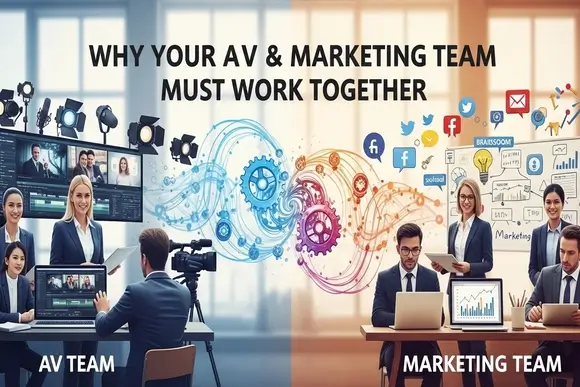
When your AV company and marketing team plan an event together from the start, the result is usually more consistent branding, smoother delivery, better audience engagement, and fewer costly last-minute problems. If they work in separate silos, even a well-funded event can feel disjointed, technically awkward, or off-brand.
Too many businesses still treat audiovisual planning as something that happens after the big marketing decisions have already been made. The campaign message is approved, the event theme is locked in, the content is nearly finished, and only then does the AV company get asked to “make it work.” That approach often creates avoidable friction. At live events, technical delivery and brand delivery are not separate things. They shape the same audience experience.
For UK businesses running conferences, exhibitions, brand activations, awards evenings, roadshows, and corporate events, that alignment matters even more. Venues vary widely, timelines get compressed, and audience expectations are high. If the marketing team wants impact but the AV company is brought in too late, the event can lose clarity, consistency, and energy at the exact moment it should feel strongest.
THE SILO PROBLEM: WHY AV AND MARKETING SO OFTEN OPERATE SEPARATELY
In a lot of organisations, marketing and event production sit in separate lanes.
Marketing is focused on the campaign, the messaging, the creative, and the audience. The AV team is often brought in later to price up the technical side and make the event happen. On paper, that might seem efficient. In reality, it often creates a gap between what the event is supposed to say and how it actually comes across in the room.
That is where things start to slip.
A brand team might sign off on visuals that look great on a laptop but feel underwhelming on a large LED screen. A speaker deck may be packed with details that no one beyond the third row can read. A carefully planned launch moment might lose all its energy because the technical setup was never designed around the creative idea in the first place.
No one sets out to create that kind of mismatch. It usually happens because the right conversation did not happen early enough.
AV IS NOT JUST THE TECHNICAL BIT AT THE END
One of the biggest mistakes businesses make is treating AV like the final stage of event planning.
AV isn’t just screens, speakers, and cables. It’s how your event is seen, heard, and remembered. It shapes the atmosphere. It influences how premium the brand feels. And it affects whether the event feels deliberate, or like it’s been assembled quickly.
Think about the moments people actually remember:
- The opening visuals and music set the tone.
- The lighting change that shifts the mood.
- The clarity of audio during a keynote.
- The pacing between sessions.
- The confidence of a presenter when everything behind them “just works.”
WHAT CHANGES WHEN AV AND MARKETING WORK TOGETHER EARLY
When the AV team is involved early, the event becomes easier to shape properly. Instead of squeezing a technical plan around already-finished content, both sides build the experience together. Creative ideas become more realistic, and technical decisions become more purposeful.
STRONGER BRAND CONSISTENCY (WITHOUT TRYING TOO HARD)
When AV understands the campaign properly, the whole event feels joined up: screen content, lighting, staging, digital signage, and transitions all look like they belong to the same brand world.
Most audiences won’t say, “The colour temperature matched the brand guidelines.”
But they will feel it when an event looks and feels polished.
BETTER USE OF SCREENS AND CONTENT
LED screens are one of the most powerful tools in live events, but only when they’re planned properly.
Marketing knows what the audience needs to see. AV knows how that content will actually read in the venue, taking into account viewing distance, pixel pitch, brightness, aspect ratio, and sightlines.
When those viewpoints come together, content lands better. Messages are clearer. Visuals feel more impactful. Screens stop being decoration and start doing real work.
FEWER LAST-MINUTE PROBLEMS
A lot of event stress comes from rushed decisions right at the end: wrong formats, late files, unclear cue points, and changing running orders.
Early collaboration doesn’t remove every challenge, but it reduces the chaos. People are working from the same plan much earlier, which means fewer avoidable surprises.
A SMOOTHER AUDIENCE EXPERIENCE
Good events have rhythm. They move with confidence. Nothing feels awkward or accidental.
That kind of flow doesn’t happen by luck. Marketing can shape the emotional arc, but AV helps bring it to life in the room.
REAL-TIME SCENARIOS WHERE THIS ALIGNMENT MAKES ALL THE DIFFERENCE
Some events feel the impact of AV and marketing alignment more than others.
PRODUCT LAUNCHES
A product launch needs more than a functioning screen and a microphone. It needs timing, entertainment, confidence, and control. If the reveal moment is supposed to create excitement, the AV company needs to understand that long before the final schedule is circulated.
When the technical delivery is built around the creative idea, the result feels sharp and memorable. When it is added in later, even a strong concept can fall flat.
ANNUAL CONFERENCES AND SUMMITS
Whether it is a conference in Manchester, Birmingham, or London, delegates expect a professional experience from the moment they walk in. That means clear branding, smooth transitions, readable content, good audio, and a visual setup that supports the day rather than fighting against it.
When AV and marketing are aligned, every session feels part of the same event rather than its own separate piece.
AWARD CEREMONIES
Awards are all about atmosphere. The music, the lighting, the screen graphics, the winner announcements, and the walk-up moments all shape how the night feels. If the AV team understands the tone and style the marketing team wants to create, those moments feel deliberate. If not, the whole thing can feel more improvised than it should.
INTERNAL COMMUNICATIONS AND TOWN HALLS
Internal events are often underestimated, but they still say a lot about a business. A well-produced town hall or company update tells people that their time matters. It helps leadership messages land more clearly. It also gives the event more energy, especially when hybrid attendees are involved.
PRACTICAL STEPS TO GET BOTH TEAMS IN THE SAME ROOM (AND SAME MINDSET)
If your current event planning process keeps AV and marketing separate, here’s how to start bridging that gap:
- Involve your AV partner at the strategy stage, not just the logistics stage. Share your campaign brief, your audience profile, and your key messages before any technical scoping begins.
- Hold joint briefing sessions between your internal marketing team and your AV production team. The conversation between a creative director and a technical director is where the best ideas are born.
- Share your brand guidelines and content assets early. Fonts, colour references (in RGB and Hex, not just Pantone), motion graphic templates, and video content all need to be reviewed against the technical specification of the displays and environment.
- Build in creative reviews at key milestones. A site visit with both teams present, particularly at a venue like The O2 Arena, the Barbican, or a regional venue new to your organisation, can surface and solve problems months before they become crises.
- Choose an AV partner who speaks both languages. Technical excellence is essential, but so is the ability to translate creative intent into production reality. Look for a team that asks about your brand, not just your rigging points.
At EMS Events, we’ve spent years working alongside marketing teams, brand agencies, and communications directors across the UK. We know that the best events aren’t the ones with the biggest budgets; they’re the ones where every decision, both technical and creative, serves the same purpose.
WHY THE RIGHT AV PARTNER MAKES SUCH A DIFFERENCE
Not every AV supplier works this way.
Some are perfectly capable on the technical side but stay narrowly focused on setup and delivery. That may be enough for straightforward jobs, but for branded live events, you need more than that.
You need a team that understands how production choices affect perception. A team that asks about your audience, your messaging, your content, and your goals, not just your screen size and power requirements.
That is often the difference between an event that works and an event that genuinely feels considered.
THE EMS EVENTS APPROACH
At EMS Events, we work with marketing teams across the UK because the best event production never happens in isolation.
We know that good AV is not just about making things visible and audible. It is about helping brands show up properly in a live environment. That means understanding the creative direction, thinking about the audience journey, and solving production challenges before they become event-day problems.
Whether it is a conference in London, a launch in Edinburgh, an awards night in Birmingham, or a hybrid event in Bristol, our role is not just to supply equipment. It is to help make the whole experience stronger.
FINAL THOUGHTS
Your AV company and your marketing team are working toward the same thing, whether they realise it or not: an event that makes the right impression.
When they plan together early, the result is more consistent, more engaging, and much easier to deliver well. The branding feels stronger. The content works better. The audience experience improves. And the event has a much better chance of doing what it was meant to do.
If you are planning an event and want it to feel polished from every angle, do not leave AV until the end. Bring your production partner into the conversation early, while the big ideas are still taking shape.
That is usually where the best event decisions begin.
FAQs
WHAT DOES AN AV COMPANY DO FOR EVENTS IN THE UK?
An AV company provides the technical production that brings an event to life, including screens, sound, lighting, staging, video, and live streaming. A strong AV partner will also help shape how those elements support the event’s overall message and audience experience.
WHEN SHOULD I INVOLVE AN AV COMPANY IN EVENT PLANNING?
As early as possible. Bringing your AV team in at the planning stage gives them time to support the venue setup, screen strategy, content delivery, and technical design before problems arise later.
WHY SHOULD MARKETING TEAMS WORK DIRECTLY WITH AV COMPANIES?
Because the way an event looks and feels affects how the brand is experienced. Marketing sets the message, but AV helps deliver that message in the room.
CAN AV PLANNING IMPROVE EVENT ROI?
Yes. Better planning usually means fewer last-minute issues, stronger branding, smoother delivery, and a better audience experience, all of which help the event perform more effectively.
WHAT TYPES OF EVENTS BENEFIT MOST FROM THIS COLLABORATION?
Product launches, conferences, award ceremonies, exhibitions, internal town halls, and hybrid events all benefit when AV and marketing are aligned from the start.