Skip to content
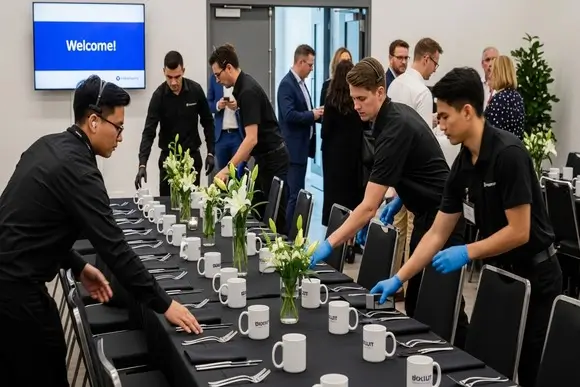
These events are usually high-stakes moments such as client recovery, urgent communication, or leadership decisions, where execution directly impacts trust, reputation, and business outcomes. Poor delivery under pressure damages credibility, while strong execution signals reliability and professionalism.
Time pressure is not a free pass for a poor event.
Every week, businesses across the UK find themselves planning a corporate event with days, not months, to spare. A client needs a briefing at short notice. Leadership calls an emergency all-hands. A product opportunity suddenly opens up, and you need to move fast. These things happen. They will keep happening.
What you cannot afford to do is let the short timeline become an excuse for cutting corners. Because in most cases, a last-minute corporate event is not a routine gathering; it is a high-stakes one. The people in that room are your most important clients, your senior stakeholders, or your key team members. What they experience reflects directly on your business.
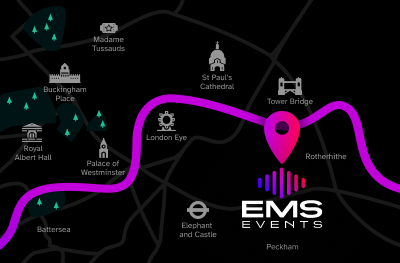
At EMS Events, we specialise in exactly this for delivering first-class event production from our Central London base, even when the brief lands late. We have seen what works under pressure and what does not. This blog covers both.
WHY THE TIMELINE DOES NOT CHANGE THE STANDARD
When an event is planned six months in advance, it tends to be a regular calendar fixture, an annual conference, a scheduled client dinner, or a planned awards ceremony. Valuable, yes. But expected. So, when an event is called at short notice, it is usually because something important has happened. A business decision needs to be communicated urgently. A client relationship needs repairing. A team needs rallying.
The people in that room will judge your organisation by what they experience. If the production is sloppy, the AV fails halfway through, or the whole thing feels thrown together, that is the memory they take away. It does not matter that you only had a week. They will not factor that in. They will just remember how it felt.
And that impression travels. Clients talk to each other. Employees talk to each other. In a world where reputation spreads fast, a poorly executed event, however understandable the circumstances, can do real damage.
| The Halo Effect of Professionalism: When an event is executed well, even at short notice, it does something powerful: it tells the room that this is how you operate under pressure. That signals competence, reliability, and trustworthiness. Those are not small things in any business relationship. |
| What they observe | What they conclude | What that means for your brand |
| Smooth AV, clear audio, clean setup. | This company is organised and professional. | Increased trust and confidence. |
| Technical failures, poor sound, rushed staging. | They did not prepare properly. | Reduced credibility and loyalty. |
| Thoughtful content, good flow, clear purpose. | This event was designed for us. | Stronger connection and engagement. |
| Generic presentation, passive audience. | We could have received this as an email. | Disengagement and wasted opportunity. |
| Quick setup but polished delivery. | They operate well under pressure. | Seen as a reliable, agile partner. |
THE REAL RISKS OF GETTING IT WRONG
Cutting corners on a last-minute corporate event is not just an aesthetic problem. The consequences are concrete and sometimes lasting.
- IT DAMAGES CLIENT TRUST
Corporate events are trust-building moments. When a client attends an event hosted by your business, they are, consciously or not, evaluating you.
They are asking:
- Are these people who deliver on their promises?
- Do they pay attention to detail?
- Do they value our time?
If your event is disorganised, that question gets answered in the wrong direction. And trust, once damaged, is difficult to rebuild. A client who leaves your event feeling underwhelmed is a client who is far more likely to take their next conversation to your competitor.
- IT AFFECTS YOUR OWN TEAM
Internal events get this wrong just as often. Leadership calls an urgent all-hands with three days’ notice, a perfectly reasonable thing to do, and then delivers it in a room where half the attendees cannot hear, the slides do not load, and the agenda is not clear.
The message employees take from that is not about the content of the meeting. It is about how much the business values their time. Poorly run internal events quietly erode morale and engagement. And in a hybrid working world where employees already have less connection to the company culture, those moments matter even more.
- IT CARRIES A FINANCIAL COST
Poor event execution has a measurable bottom-line impact. Disengaged clients are less likely to renew contracts or expand their relationship with you. Disengaged employees are less productive and more likely to leave, and replacing a single employee costs, on average, a significant multiple of their monthly salary.
Research from McKinsey has found that inefficient decision-making and poor communication processes cost large organisations hundreds of millions of pounds annually. Events are a frontline communication tool. When they fail, the ripple effect runs further than most businesses appreciate.
WHAT FIRST-CLASS LOOKS LIKE WHEN TIME IS SHORT
First-class does not mean opulent. It does not require weeks of preparation or a huge budget. It means that every element of the event, sound, visuals, staging, flow, and content has been thought through and delivered properly. Here is what that looks like in practice.
1. Sound is always the first priority
If attendees cannot hear clearly, nothing else matters. Clear, properly calibrated audio is the single most important production element in any corporate event. It is also one of the most commonly underinvested in when time is short.
A professional production team will always do a proper sound check before anyone enters the room. Not a quick test, a full check for every microphone, every speaker position, every corner of the room. This is non-negotiable, regardless of the timeline.
2. Visuals should support the message, not fight it
Whatever you are showing on screen, whether slides, video, live feeds, or data, it needs to be visible, readable, and purposeful. A properly configured LED video wall or projection setup that is calibrated for the room will do more for your event than a bigger screen that has not been set up correctly.
Rushed visual production is one of the most obvious signs that an event was thrown together. Slides that do not match the screen ratio, video that buffers, fonts too small to read from the back of the room, these are all avoidable with the right production partner in place.
3. Staging and layout shape the whole experience
The physical setup of the room tells people what kind of event this is before a single word is spoken. Stage design does not need to be elaborate to be professional. It needs to be intentional. The right positioning of the speaker, the right sightlines for the audience, and the right lighting to set the tone, these things can be achieved quickly with an experienced team.
A theatre-in-the-round format, for instance, creates intimacy and removes the psychological distance between speaker and audience without requiring a large budget or long setup time. It is the kind of decision that experienced production teams make quickly, because they have done it before.
4. Hybrid capability should be ready, not retrofitted
With a significant number of UK corporate events now requiring both in-room and remote participation, hybrid production cannot be an afterthought. If your event is being called at short notice, there is a good chance that some of your key attendees will not be able to travel. Retrofitting a stream into a room that was not set up for it is one of the most common last-minute production failures.
The solution is to work with an event production partner who can deploy hybrid-ready equipment as standard. Whether attendees are in the room or watching remotely, they should receive the same quality of experience.
5. Content needs a structure, not just slides
Even with 48 hours to prepare, your event content should have a clear beginning, middle, and end. People need to know why they are there, what is being communicated, and what they should do or feel at the end of it. A well-structured event, even a short one, always lands better than a long one with no clear shape.
Brief the speaker well. Have a clear run-of-show document. Know what the first and last things the audience will hear are. These are not complex requirements. They just need someone to own them.
| Related Reading: For more on why narrative structure, audience participation, and intentional design outperform polished visuals every time, read our deep dive on why the most effective corporate events today are experiences, not spectacles. |
HOW TO MEASURE WHETHER YOUR LAST-MINUTE EVENT WORKED
Every event, regardless of how quickly it was planned, should be measured, not just by asking, ‘Did people enjoy it?’ but also, ‘Did it achieve what it was supposed to?’
The clearest framework for this is what event strategists call the Think, Feel, Know, Do model. Before your event, define what you want attendees to leave with across each of these dimensions:
- Think: Has their perspective shifted? Do they see the situation differently from how they did before they arrived?
- Feel: What emotion do you want them to leave with? Confident? Reassured? Motivated? Proud? Name it before you design the event.
- Know: What specific information needs to land? Are they leaving with clarity on the next steps, the new strategy, or the key message?
- Do: What action do you want them to take after the event? This is the most important one, and the most frequently skipped.
Once those four things are defined, your event has a clear purpose. And you can measure it. Post-event surveys, Net Promoter Scores, engagement data from event apps, and pipeline tracking for client events all give you hard data to take back to the business.
A last-minute event that you can prove worked is far more valuable than an annual event that felt fine but delivered no measurable outcome.
| Did You Know? 63% of event professionals now use AI-driven personalisation tools, even for short-notice events. |
TO PEN DOWN
There is a version of every last-minute corporate event that falls short. The slides do not load. The sound cuts out. The agenda runs over. The room feels like it was thrown together, because it was.
And there is a version that lands properly. That feels considered, even if it was planned in 48 hours. That leaves clients feeling valued, employees feeling engaged, and leadership feeling like their organisation handled pressure well.
The difference between those two versions is almost never about time. It is about the standard you hold, the team you work with, and the decisions you make when the clock is running.
Last-minute is a timeline. First-class is a choice. Make the right one.
Need an event sorted fast? Whatever your timeline, EMS Events delivers first-class production from our Central London base. We have over 30,000 pieces of equipment in stock, a professional technical team, and 25+ years of experience to make it happen properly.
FAQs
CAN YOU REALLY DELIVER A FIRST-CLASS CORPORATE EVENT AT SHORT NOTICE?
Yes, provided you are working with a production partner who has the right stock in-house, the right team on standby, and the experience to make fast decisions without compromising on the details that matter.
WHAT IS THE MINIMUM NOTICE NEEDED TO BOOK EMS EVENTS FOR A CORPORATE EVENT?
We handle briefs with varying timelines, including urgent requests. The best thing to do is call us directly on 0207 820 9000 and tell us your date, your venue, your headcount, and your objective. We will tell you honestly what we can deliver and how.
WHAT ELEMENTS OF EVENT PRODUCTION SHOULD NEVER BE COMPROMISED, EVEN UNDER TIME PRESSURE?
Sound is always first. If the audience cannot hear clearly, everything else fails. After that: visual clarity, room layout and staging, and having a clear run-of-show for speakers and production team. These four things can be executed well even with a very short timeline; they just require a disciplined and experienced team.
HOW DO YOU MEASURE THE ROI OF A LAST-MINUTE CORPORATE EVENT?
Start by defining what success looks like before the event, not after it. Use the Think, Feel, Know, Do framework to set objectives. Then measure against them: post-event surveys, Net Promoter Scores, engagement data, and longer-term metrics like client retention or employee engagement scores. A well-defined objective makes measurement straightforward, regardless of how much notice you had.
WHAT IS THE RISK OF USING A PRODUCTION COMPANY THAT IS NOT BASED LOCALLY?
Significant. For last-minute events, logistics time is critical. A production partner who needs to travel three hours to reach your venue is a production partner who has already lost a quarter of your available setup time. Our Southwark base puts us minutes from Central London’s key event venues, which is a genuine operational advantage when time is tight.