Skip to content
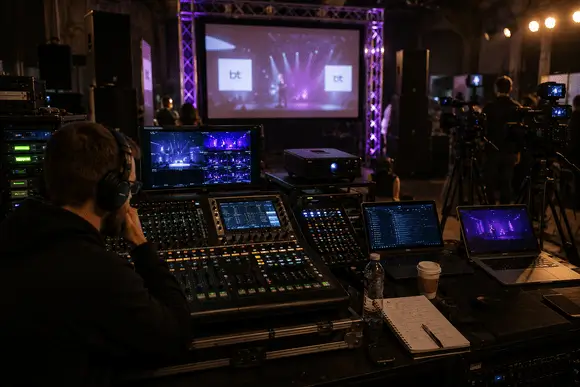
Basic AV is no longer enough for most corporate events because clients now expect every technical element to work together as one joined-up system. That means sound, screens, lighting, content, streaming, interpretation, staging, and on-site support all need to be planned together, not hired separately.
There was a time when booking AV for a corporate event meant arranging a projector, a microphone, and hoping the Wi-Fi behaved. Those days are gone.
Today, corporate clients expect much more. They do not want a pile of equipment. They want technology that supports the whole event experience, protects the message, and reduces risk on the day. At EMS Events, we have seen that shift happen across more than 20,000 events over 25+ years, working from our Southwark base near Tower Bridge with in-house stock, crews, and production support.
This is not just about better screens or louder sound. It is about integration. And for corporate event planners in London and across the UK, that has changed the standard completely.
What “basic AV” used to mean and why it no longer works
Basic AV used to be transactional. You asked for a few microphones, a screen, some speakers, and perhaps a projector. A supplier delivered the kit, plugged it in, and hoped the room behaved.
That approach worked when the event itself was simpler. One audience. One presenter. One slide deck. No live stream. No animated content. No remote speakers. No multilingual delegates. No expectation that the event would also generate polished content for internal teams or post-event use.
That is no longer how most corporate events work.
Today, even a standard conference in Central London may involve presenter confidence monitors, branded content playback, a live camera feed, remote contributors, audience Q&A, a webcast, and post-event recordings. Once those moving parts are involved, basic AV stops being enough. The issue is not that the equipment is wrong. The issue is that the event now depends on how different technologies work together.
When that joined-up thinking is missing, problems show up quickly. Slides do not display correctly. Audio does not translate well to the stream. Timing slips between stage action and screen content. The audience may not know exactly what went wrong, but they will feel it. And that reflects directly on the organiser.
What full technology integration actually means
Full technology integration means every technical element of the event is planned, delivered, tested, and operated as one connected system by one accountable team.
That includes audio, video, LED display, lighting, content playback, live streaming, interpretation, staging, cueing, and technician support. It is not about adding more kit for the sake of it. It is about making sure the right elements work together properly.
In practical terms, it means the team handling the screen content understands the format of the display. The streaming feed is built around clean audio and the right visual output. Interpretation is not treated as a separate add-on. Speaker cues, transitions, holding slides, and walk-on moments are planned in advance. The technical side of the event supports the message instead of competing with it.
That is the real difference between hire and integration.
Why corporate clients now expect more
There are a number of reasons behind the shift:
Basic AV no longer matches how corporate events work
A projector, a few microphones, and a technician on standby may have worked when events were simpler. That is not how most corporate events work now.
One connected technical system is now the demand
Today, clients expect technology to function as one connected system. Audio, video, lighting, content playback, streaming, and room control all need to support the same experience. The shift is not only about having better equipment. It is about making sure everything works together properly, with less friction for presenters, organisers, and audiences.
Hybrid delivery raised the standard
This matters even more in hybrid settings. If the people in the room can hear and see clearly, but remote attendees struggle with weak audio, poor camera framing, or delayed content, the experience quickly becomes uneven. That affects engagement and makes the event feel less professional.
Corporate spaces are expected to feel more intelligent
Corporate clients are also expecting more intelligent spaces. They want simpler room control, smoother switching between platforms, more reliable content delivery, and less visible technical effort. In many cases, that now includes smarter cameras, clearer microphone systems, more connected workflows, and stronger compatibility with the wider technology environment of the business.
Visual expectations have changed too
Clients are paying closer attention to brightness, screen quality, branding, and how content looks both in the room and on camera. That is why more events now rely on integrated visual systems rather than basic display setups alone.
The real value is better control
The real value of full technology integration is not complexity. It is control. It reduces technical gaps, improves the audience experience, and gives organisers one joined-up system instead of a collection of separate moving parts.
The bar has risen for three simple reasons
Hybrid and virtual events changed expectations permanently
Hybrid events did more than add cameras to meeting rooms. They forced organisers to think about two audiences at once: the people in the room and the people joining remotely. Event teams became much more aware of sound quality, camera framing, stream reliability, visual clarity, and content timing. Once a client has seen what a well-produced event looks like, it becomes very hard to go back to a basic setup and call it good enough.
Audiences are less patient
Corporate audiences are busy, distracted, and much less forgiving of technical delays than they were a decade ago. At a conference in the City of London or Canary Wharf, people are often watching the clock, checking email, and deciding within seconds whether the session feels worth their attention. A delay in playback, a weak opening, or a sound issue breaks momentum. And once momentum drops, attention goes with it.
Content now sits inside the production brief
More clients now expect the event to do more than deliver a live experience. They want footage, recordings, branded visuals, presentation support, animated content, and clean assets that can be reused afterwards. That means content and production cannot sit in separate lanes anymore. A better result comes when content and technical delivery are designed together from the start.
Where basic AV breaks down: a quick example
Take a general corporate conference in Central London. The client has 200 people in the room. Another 400 are joining remotely. There is a leadership panel, a video opener, live audience Q&A, branded stings between sessions, and simultaneous interpretation for international delegates. The room also needs side screens, a main LED wall, presenter monitors, and a clean recording to send internally the next day.
On paper, this can still look like an AV booking. In reality, it is a live production workflow.
The stream needs a clean feed from the room. The room needs visuals that work for both the audience and the camera. The interpretation system needs to connect cleanly with the programme audio. The LED wall content needs to match the speaker deck. The technicians need to know when speakers are walking on, when videos are playing, and when a remote contributor is about to join.
If five different suppliers are managing those parts, the chances of delay, miscommunication, or inconsistency go up sharply. If one experienced team is managing them as a single system, the day is calmer, the quality is stronger, and the organiser has one clear point of accountability.
That is what clients are really asking for when they say they want “full production support”.
What event planners should now ask their AV partner
Many planners are still asking equipment questions when they should be asking workflow questions. A better starting point:
A strong partner should not just quote for screens, microphones, or lighting. They should explain how the room, the content, the stream, and the on-site operation connect.
In-house teams usually know their own stock, workflows, standards, and backup processes far better than a supplier relying heavily on ad hoc staffing. EMS Events’ in-house setup, warehouse capability, and broad equipment holding are part of that value.
Slide formatting, video playback, branded holding screens, cue sheets, speaker transitions, and confidence monitor planning all matter. Problems caught before the event are cheaper and easier to fix than problems caught live in front of delegates.
These elements are often treated as separate bookings. They should not be. They affect one another directly.
The best production partners show their value when the plan shifts. A speaker runs late. A video needs swapping. A remote presenter has an audio issue. A room layout changes. Strong teams absorb that pressure without letting the audience feel it.
Is full technology integration worth the investment?
For a small internal meeting, not always. For a leadership event, client-facing conference, AGM, product launch, awards evening, or hybrid event, very often yes.
The reason is simple. The cost of visible failure is usually higher than the cost of doing the job properly. A technical problem in front of senior stakeholders does not just interrupt the event. It affects confidence in the organiser, the message, and sometimes the brand itself.
Good integration also improves value in quieter ways. It reduces stress for the organiser. It helps presenters perform better. It makes content easier to repurpose. It gives the event a more controlled, professional feel. And it usually means fewer gaps between what was promised and what the audience actually experiences.
Why this matters even more in London
London events come with their own pressure points. Venues vary widely. Access windows can be tight. Historic properties can limit rigging and layout choices. Corporate audiences are often senior, time-poor, and less tolerant of disruption. In areas like Westminster, the City, Southwark, and Canary Wharf, expectations are high because the events themselves often carry commercial, reputational, or internal importance.
That is why joined-up planning matters so much here. It is not about overcomplicating the job. It is about making sure the event works in the real conditions in which it is being delivered.
Final thought
Basic AV is not dead because microphones and screens no longer matter. It is dead because those things on their own are no longer enough for the way corporate events now work.
Clients expect more because events now carry more weight. They have bigger audiences, more formats, more content demands, and less tolerance for failure. Full technology integration is the response to that reality. It gives organisers clearer control, fewer technical gaps, and a better chance of delivering an event that feels confident from start to finish.
At EMS Events, that is how we approach production: not as a list of hired items, but as one connected system built around the audience, the venue, and the message.