Skip to content
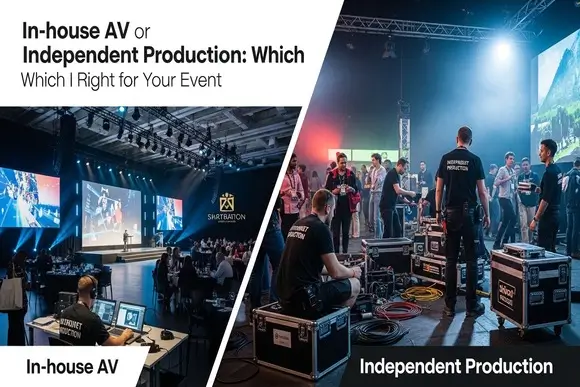
In-house AV is ideal for small, low-complexity meetings (10–30 people) where you only need a single screen and a “plug-and-play” laptop connection. Independent production (like EMS Events) is the right choice for conferences, AGMs, and gala dinners where branding, custom stage design, 4K LED video walls, and flawless live streaming are non-negotiable. While in-house AV offers convenience, independent teams offer specialised talent and transparent pricing free from venue markups.
In the high-stakes world of 2026 corporate events, where hybrid setups, AI-driven tracking, and immersive LED walls are the new standard, choosing the wrong technical partner isn’t just a budget mistake; it’s a brand risk.
This guide gives you a proven framework to help you make the right call for your specific event.
WHAT DOES “IN-HOUSE AV” ACTUALLY MEAN?
When a venue says it has in-house AV, it usually means one of two things: either the venue employs a small internal team, or they have an exclusive contract with a supplier who operates inside the building.
The word to watch for is “exclusive.” In many cases, you aren’t choosing this team because they are the best technical fit; you’re using them because they are the default. In-house teams are set up for volume. They know where the power sockets are, but they often use “cookie-cutter” setups. For a small board meeting, that’s fine. But the moment your event requires a hybrid broadcast, custom staging, or theatrical lighting, you’ll likely hit the ceiling of what their equipment can handle.
| 💡 Good to know: Check your contract for “outside vendor fees.” These can be 30–40% of your budget. Negotiate these out before you sign the venue agreement; once the ink is dry, your leverage disappears. |
WHAT DOES AN INDEPENDENT PRODUCTION COMPANY ACTUALLY OFFER?
An independent partner like EMS Events is a specialist team that works for you, not the venue. At EMS, we manage the entire “vibe” of the event. Our capabilities include:
- Massive Inventory: 32,000+ pieces of gear (LED walls, audio, lighting) in our 18,000 sq ft Tower Bridge warehouse.
- Dedicated Support: A single project manager who stays with you from the first brief to the final pack-down.
- Bespoke Design: We don’t just “set up a stage”; we build a brand experience tailored to your specific goals.
IN-HOUSE AV VS INDEPENDENT PRODUCTION: THE FULL COMPARISON
Before we get into specific scenarios, here’s the side-by-side picture across the factors that matter most:
| Factor | In-House AV | Independent Production |
| Convenience | Easy, already at the venue | Needs coordination, but manageable |
| Equipment Range | Standard stock, the same for every event | Full warehouse inventory, latest tech |
| Creative Flexibility | Template-based, predictable | Fully bespoke, stage, lighting, and content |
| Dedicated Focus | Shared across multiple rooms | 100% focused on your event only |
| Pricing Transparency | Bundled, often unclear | Fully itemised, no hidden extras |
| Brand Control | Functional, but generic | On-brand storytelling end-to-end |
| Hybrid/Streaming | Basic, if available at all | Full broadcast-quality production |
| Lighting Design | Static house lighting only | Dynamic, branded lighting as narrative |
| Multi-Venue Consistency | Restarts from zero each time | Same team, same standards, everywhere |
| 24/7 Support | Office hours, shared crew | Dedicated 24-hour technical support line |
| Event-Day Ownership | Split with venue priorities | Solely accountable to your brief |
THE PART NOBODY TALKS ABOUT ENOUGH: HIDDEN COSTS
Let’s talk about the thing that surprises more event planners than anything else: the real cost of in-house AV.
On paper, it looks cheaper. It’s bundled into your venue package. There’s no extra supplier to manage. But the headline figure is almost never the full figure. Here are the charges that regularly don’t appear until your invoice arrives:
- Commission markups: In-house AV vendors usually pay the venue a commission on everything they charge you; industry sources suggest this can reach 40–60% of the total AV bill. That commission is quietly baked into your quote.
- Infrastructure fees: Power usage, internet connectivity, and rigging point access are routinely charged separately and rarely mentioned at the enquiry stage.
- Supervision fees: Some venues charge for a venue technician to be present whenever an external element is used, even if you’ve brought in your own team.
- Overtime charges: In-house contracts often include tight overtime clauses. Events overrun. The fees follow.
- Buyout penalties: If you later decide to bring in an external supplier after signing, expect to pay a penalty. In some venues, this runs to 30–40% of the AV value.
- Labour minimums: Some venue AV contracts carry mandatory labour minimums; you pay for crew time whether you use it or not.
With a reputable independent production company like EMS Events, pricing is itemised and transparent. You see every line: equipment hire, crew, transport, design time, and any bespoke elements. No commission structure inflates the numbers behind the scenes. No post-event surprises.
| Before you sign the venue contract: Check for these specific clauses, “exclusive AV supplier,” “preferred vendor requirement,” “outside vendor fee,” “patch fee,” and “dock access restrictions.” These are your leverage points, and they only matter before you’ve committed. A good venue will negotiate on these, especially if you’re bringing meaningful room nights or F&B spend. |
THE HYBRID EVENT FACTOR: WHERE MOST IN-HOUSE SETUPS FALL SHORT
Hybrid events, where you’re running a live audience and a simultaneous remote audience, are not just live events with a camera bolted on. They require a fundamentally different production architecture: broadcast-quality cameras, vision mixing, streaming encoders, low-latency delivery platforms, an independent audio feed for the online audience, redundant internet connections, and a production team actively managing both audiences throughout.
Most venue in-house AV setups are not built for this. They may offer basic webcasting functionality, but the kind of professional hybrid production that makes remote delegates feel genuinely present, rather than watching a grainy screen share, requires specialist expertise and equipment that standard house systems rarely carry.
- EMS Events has delivered over 100 successful webcasts and hybrid productions, including global AGMs where shareholders connect from multiple time zones simultaneously.
- Every hybrid production includes a single integrated plan covering the in-room experience and the remote audience, with cameras, switching, streaming, audio, and content formats designed for both from the start.
- Technical rehearsals with speakers, redundant streaming connections, and dedicated on-site engineers are standard, not optional extras.
The shift towards hybrid is not slowing down. Research consistently shows that event planners view hybrid capability as central to their future strategy. If hybrid delivery is any part of your brief, now or in the next 12 months, your AV partner selection is not a peripheral decision. It is a strategic one.
THE “L” IN AVL: LIGHTING AS A BRAND TOOL, NOT AN AFTERTHOUGHT
Most people focus on “Audio” and “Visual.” Lighting is treated as an afterthought, usually just “turning the room lights up.”
Professional lighting design is a narrative tool. It guides the audience’s attention, reinforces your brand colours, and sets the mood. In-house AV typically offers static lighting, while independent production teams can treat lighting as a design element, using intelligent fixtures and programmed cues to create a more polished event experience.
MULTI-VENUE CONSISTENCY: THE ADVANTAGE NOBODY MENTIONS
For corporate teams running a roadshow, a series of regional conferences, or multiple events across different venues throughout the year, this is actually one of the strongest arguments for an independent production partner.
Using the venue’s in-house AV team every time means starting from scratch with a new crew at every location: new people to brief on your brand, new technicians who don’t know your speaker’s habits, and new dynamics to manage on the day. Every event carries fresh risk.
An independent production company travels with you. The same team learns your brand standards, your presentation preferences, your typical technical requirements, and your quality expectations. The venue changes, but the experience your audience receives doesn’t.
| 🏆 Client relationship example: Rafael Azzopardi, Head of Events at Regent’s University London, has partnered with EMS Events across multiple venues for over 12 years, consistently citing technical expertise and the value of working with a team that already understands his events inside out, regardless of which venue they’re in. |
SUSTAINABILITY: AN INCREASINGLY IMPORTANT FACTOR
ESG considerations are now firmly part of corporate event procurement in the UK, and yet this dimension almost never appears in discussions about AV partner selection. It should.
Questions worth asking when evaluating your options include:
- Does the AV company have a published sustainability policy?
- Is the company ISO 20121 certified for sustainable events management?
- Do they use energy-efficient equipment?
- Do they offer hybrid event formats as an explicit tool for reducing the carbon footprint of your delegate travel?
EMS Events actively adheres to ISO 20121 sustainable events management standards, using energy-efficient equipment, minimising waste through reusable methods, and supporting renewable energy where possible. For organisations with formal ESG reporting requirements, this is no longer a peripheral concern; it’s part of the evaluation.
EVENT-TYPE DECISION MATRIX
Not sure which model fits your upcoming event? Use this as a quick reference:
| Event Type | Best Choice | Why? |
| Small internal meeting/training | In-House AV | Basic setup sufficient, low risk. |
| Corporate conference (200+ delegates) | Independent Production | Complex staging, sound, full crew. |
| Gala dinner/awards ceremony | Independent Production | Lighting design, brand aesthetics, wow-factor. |
| AGM with webcast | Independent Production | Streaming, interpretation, compliance support. |
| Product launch/brand activation | Independent Production | LED walls, custom set, experiential tech. |
| Hybrid/virtual event | Independent Production | Dual-audience design, streaming, redundancy. |
| Small seminar (under 50 pax) | In-House AV | Basic AV is sufficient and cost-effective. |
| Multi-city roadshow | Independent Production | Cross-venue consistency, portable team. |
| Exhibition with a stage element | Independent Production | End-to-end build, exhibition + production. |
| ⚡ Shortcut rule: If your event will be seen by senior stakeholders, broadcast to a remote audience, or represents your brand to anyone outside your building, the quality of your production is not a line item to cut. The right independent partner, like EMS Events, more than pays for itself in outcomes. |
IF YOU GO INDEPENDENT: HOW TO CHOOSE THE RIGHT PRODUCTION PARTNER?
Not all independent AV companies are equal. Here’s what to look for when you’re evaluating your options:
- Track record in your event type. Ask for case studies and client references specific to conferences, awards, AGMs, or whatever your event format is. A strong general portfolio is not enough.
- Owned equipment inventory. Find out whether the company owns its equipment or subleases from third parties. Owned inventory means more reliability, faster problem-solving on the day, and better cost control. EMS Events’ 32,000-piece in-house inventory is a significant advantage here.
- Dedicated project management. You should have a single named project manager who is accountable from the initial brief through to breakdown. Not a shared inbox or a rotating contact.
- Fully itemised quotes. Ask for line-by-line pricing. Any company that can’t or won’t show you the individual cost of each element is a red flag.
- Out-of-hours technical support. Events don’t cooperate with business hours. A 24-hour support line is not a luxury; it’s a basic requirement for anything high-stakes.
- Local logistics. For London events, proximity matters for emergency support and fast equipment deployment. EMS Events operates from an 18,000 sq ft warehouse near Tower Bridge, enabling rapid response across Central London.
- Sustainability credentials. Check for a published environmental policy and ISO 20121 certification if ESG alignment matters to your organisation.
So, choose the AV partner that fits the technical demands, brand expectations, and risk level of your event.
FAQs
WHAT IS THE DIFFERENCE BETWEEN IN-HOUSE AV AND AN INDEPENDENT PRODUCTION COMPANY?
In-house AV refers to audio-visual services provided directly by a venue or its contracted exclusive supplier, typically covering basic sound, projection, and house lighting. An independent production company is a separate business engaged specifically for your event, bringing its own equipment, crew, and creative expertise. Independent companies offer broader capabilities, dedicated attention, transparent pricing, and consistency across venues.
IS IN-HOUSE AV CHEAPER?
Not always. Once you add venue commissions and hidden “patch fees,” independent production often provides better gear and more talent for a similar all-in cost.
CAN I BRING MY OWN AV COMPANY TO A HOTEL OR CONFERENCE VENUE?
Usually, yes. However, you must negotiate the “outside vendor” clauses in your venue contract before you sign.
WHEN DOES A HYBRID EVENT REQUIRE AN INDEPENDENT PRODUCTION COMPANY?
Almost always. Hybrid events, where you’re delivering simultaneously to a live audience and remote participants, require broadcast-quality cameras, vision mixing, streaming encoders, low-latency delivery platforms, independent audio feeds, and redundant internet connections. Most venue in-house AV setups are not equipped for this level of production. Independent companies with specific hybrid event experience, like EMS Events (100+ webcasts and hybrid productions delivered), design a single integrated production plan for both audiences.
WHAT SHOULD I LOOK FOR WHEN CHOOSING AN INDEPENDENT AV PRODUCTION COMPANY?
The key criteria are: a strong track record specifically in your event type, an owned equipment inventory (not subhired), dedicated project management with a single named contact, fully itemised quotes, 24-hour technical support, and strong client references.