Skip to content
TL;DR
Physical booths are well suited to many in-person conferences, while RSI works particularly well for hybrid and virtual events and can support selected in-person formats. If venue space is limited, compare compact booths, alternative booth locations and RSI before choosing the setup.
For many in-person conferences, an on-site interpretation booth provides a reliable setup. RSI is well suited to hybrid and virtual events and can also support selected in-person formats when the technical setup is properly planned.
If you are planning simultaneous interpretation for a conference and trying to save space at the venue, remote simultaneous interpretation (RSI) sounds like the obvious answer. That may be one solution, but the right setup depends on the venue, audience format, language requirements and technical infrastructure.
For many in-person conferences, a physical interpretation booth remains a strong choice because it keeps interpreters close to the live production environment. RSI is especially useful for hybrid and virtual events, but it can also support selected in-person conferences when the event infrastructure is designed for remote interpretation.
This guide covers what each option actually is, when each is right, and what to check before choosing.
What is a physical interpretation booth?
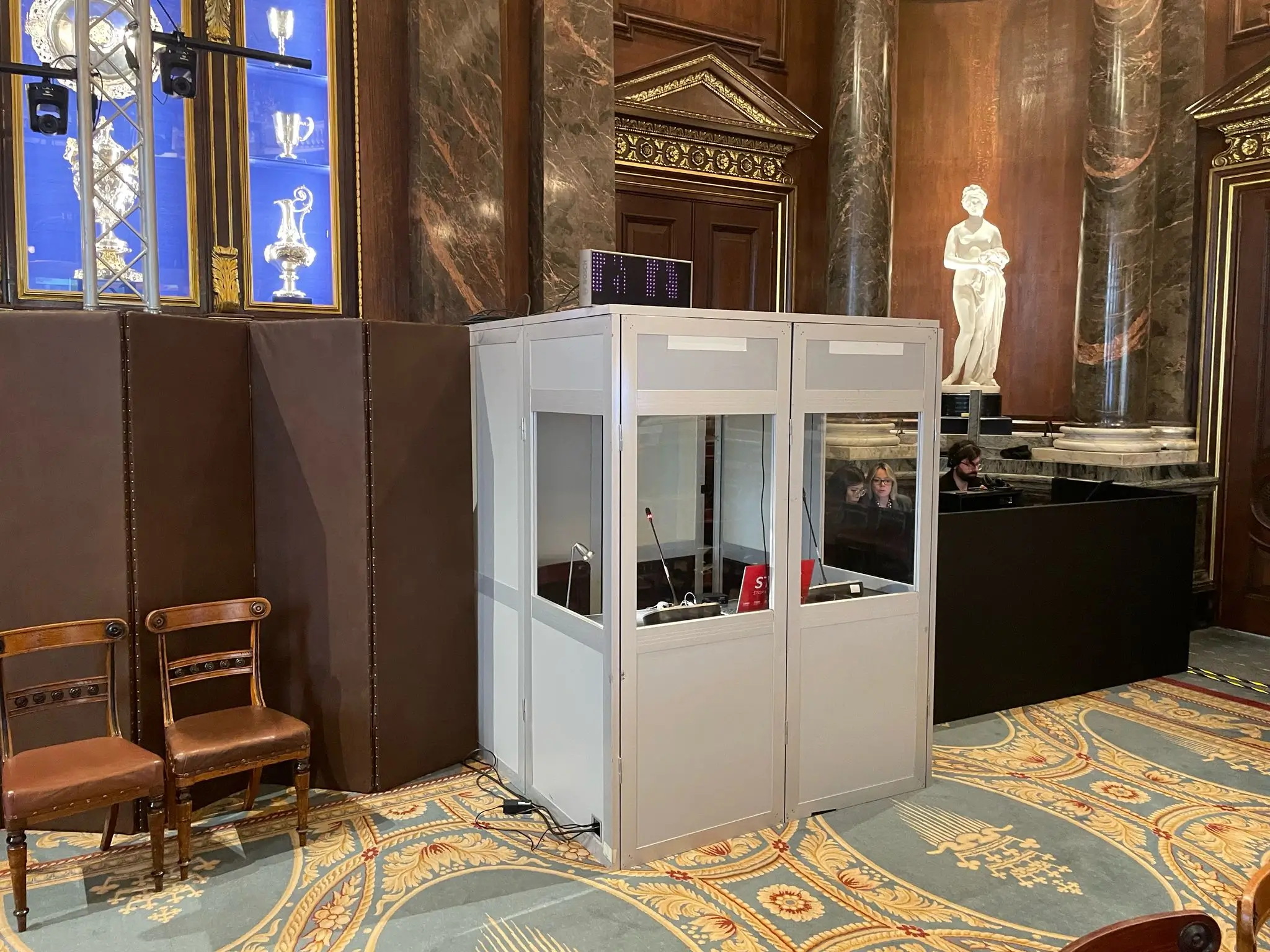
A physical interpretation booth is a sound-isolated enclosure inside or beside the conference room where interpreters work live. Two interpreters per language sit together in the booth, listen to the speaker through headphones fed directly from the venue’s sound mixer, and speak the interpreted output into a microphone that reaches delegates through wireless receivers.
Interpretation booths are designed around recognised standards covering acoustic isolation, visibility, dimensions, ventilation and interpreter working conditions. The ISO 17651 series covers permanent and mobile booths used for simultaneous interpreting, with the appropriate configuration depending on the venue and event requirements.
What is remote simultaneous interpretation (RSI)?
RSI moves the interpreters out of the venue entirely. Interpreters work from a remote location, often a dedicated hub with proper acoustic conditions, and join the event through a video link. Delegates receive the interpreted audio through an app on their phone, a web platform, or, in some setups, a dedicated receiver connected to the RSI provider.
For a fully virtual event, RSI is often the only realistic option. For a hybrid event with an online audience, RSI naturally extends interpretation to remote delegates. For an in-person conference, RSI can reduce the need for physical booth space, but it requires a properly engineered audio path, stable connectivity, suitable interpreting technology and clear contingency planning.
Booth or RSI: how to choose
The decision usually follows the audience shape, not the venue constraint. This is the summary; the sections below explain each option in more detail.
| Event shape | Physical booth | RSI |
| In-person conference, in-room audience only | Recommended | Possible where the technical setup supports it |
| Hybrid conference with online audience needing interpretation | For the in-room delegates | For the online delegates |
| Fully virtual event | Not applicable | Recommended |
| High-stakes formal event (AGM, board, government) | Recommended | Requires robust technical planning and redundancy |
| Short internal meeting under 40 minutes | Sometimes over-scoped | May be appropriate |
| The venue cannot accommodate a standard booth. | Consider a tabletop or off-room booth first. | One solution to consider alongside compact or off-room booth setups |
If the answer above still points to RSI, but the reason is venue space rather than audience shape, the booth side of the comparison is usually where the real answer lies. If venue space is driving the decision, consider the available booth configurations before ruling out an on-site setup.
When an On-Site Interpretation Booth Works Best
Physical booth interpretation is often well suited to larger in-person conferences, formal international events and productions where interpreters need direct access to the live event environment. Specifically:
- In-person conferences with a mostly or fully in-room audience
- High-stakes events (AGMs, government briefings, board-level meetings, international negotiations)
- Events where delegates in the room need to interact with the interpreted content in real time (Q&A sessions, panel discussions)
- Venues with reliable existing power and space, even if the space is modest
- Events where minimising reliance on external internet connectivity is an important production requirement.
The trade-off is space. A single-language booth takes roughly 2m x 2m of floor area, plus interpreter access. A two-language conference needs two booths, a three-language conference needs three, and so on.
When RSI Works Best
RSI is particularly effective when interpreters or delegates are joining remotely, or when the event already includes a virtual or hybrid audience.
- Fully virtual events with a distributed audience.
- Hybrid events with a significant online audience needing interpretation.
- Shorter meetings where a full on-site booth configuration may be disproportionate to the programme length and technical requirements.
- Events at venues where booth installation is restricted by floor space, access limitations or venue-specific requirements.
- Events with rare language combinations where suitable interpreters are only available remotely.
For hybrid events, EMS Events can integrate RSI with the wider virtual event production setup, including speaker audio, interpretation channels and the online delegate experience.
If venue space is the constraint, check these first
Before choosing RSI primarily to save space, check whether one of these booth configurations can solve the same venue constraint.
- Tabletop booths: A compact interpretation setup for venues where floor space is limited. Their suitability depends on session length, acoustic conditions, interpreter requirements and the wider technical setup.
- Booth positioning against a rear wall: Booths do not need to be central. Placing them against a back wall or in an unused corner often frees more usable space than organisers assume.
- Adjacent-room interpreter setup: Where the main room cannot accommodate the required booths, a nearby room may be equipped with the necessary audio and visual feeds so interpreters can follow the event without taking floor space from delegates.
If space remains limited, RSI can also be considered. The final choice should account for venue layout, audience location, programme format, connectivity and the technical requirements of the interpretation setup.
Getting the right setup for your event
The right interpretation setup depends on how delegates attend, how interpreters participate and how the venue’s technical infrastructure supports the production. At EMS Events, we plan on-site, remote and hybrid simultaneous interpretation setups for conferences and events across London. Depending on your requirements, this can include interpretation booths, interpreter equipment, delegate receivers, audio routing and integration with hybrid or virtual event production. Share your venue, audience format, programme length and language requirements, and our team can specify the setup that works for your event.
FAQs
Do I need a soundproof interpretation booth, or can interpreters work remotely from headphones now?
Both on-site booths and RSI can support simultaneous interpretation, but they serve different event requirements. Physical booths are commonly used for in-room conferences, while RSI is particularly useful for hybrid and virtual formats. For some in-person events, RSI can also work when connectivity, audio routing and platform integration are properly planned.
How much space does a mobile interpretation booth take up?
Mobile interpretation booth dimensions vary by booth type and event configuration. A full-size booth requires dedicated floor space plus interpreter access, while compact or tabletop setups may require less. EMS Events can assess the venue layout and recommend an appropriate booth configuration.
Is RSI cheaper than a physical booth?
The final cost depends on the number of languages, interpreters, delegate access method, platform requirements and wider AV setup. RSI may reduce physical booth requirements while adding platform and integration costs. Compare the complete technical scope of each setup rather than individual equipment or platform prices.