Skip to content
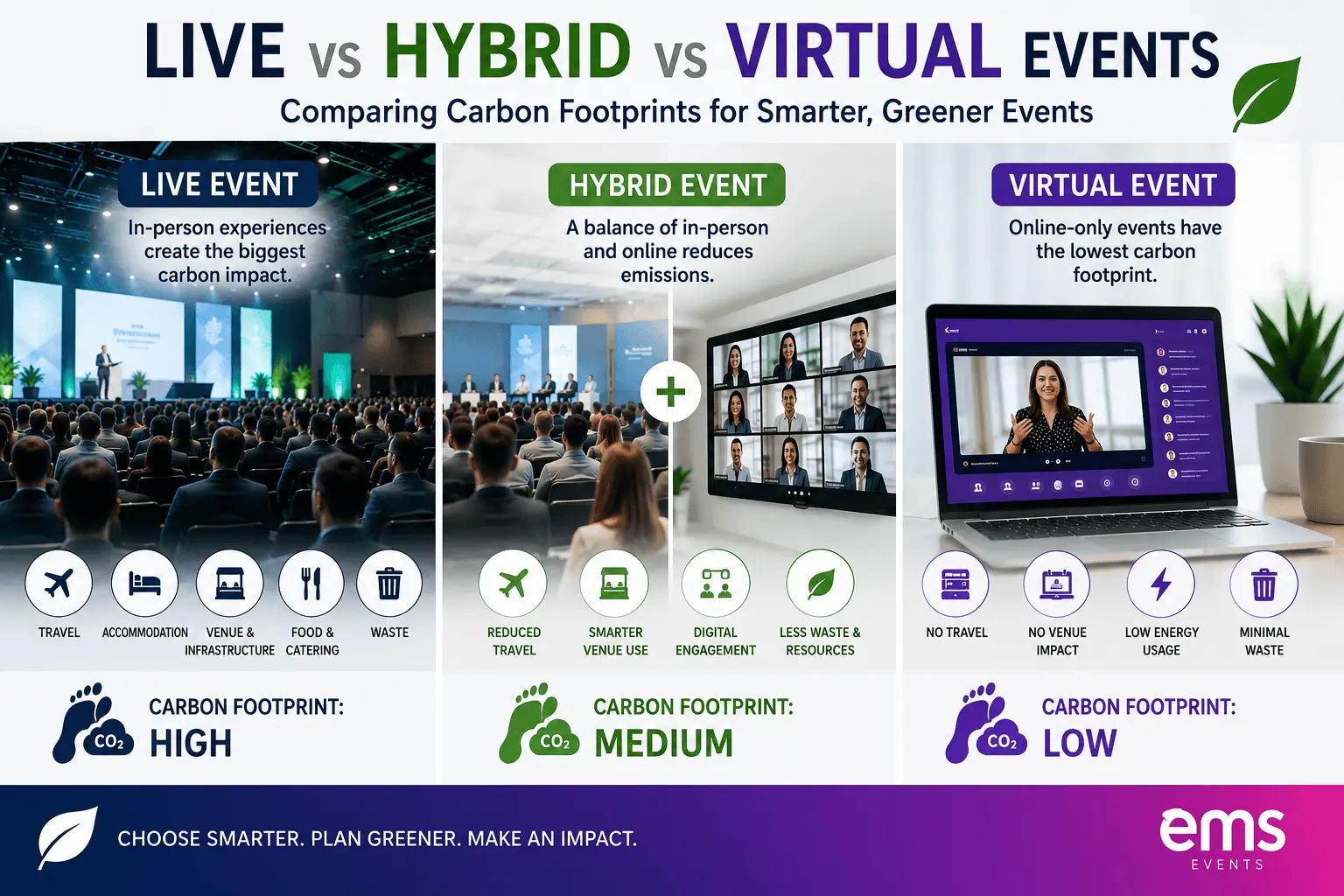
Virtual events usually create the lowest carbon footprint. Live events usually create the highest, especially when long-haul travel is involved. Hybrid events sit between the two, but only when they are planned around reduced travel, regional hubs and meaningful virtual participation.
One peer-reviewed life cycle assessment estimated the footprint of a single-hub in-person conference at around 840 kg CO₂e per participant, while a fully virtual version came in at around 46 kg CO₂e per participant. That is roughly a 94% reduction. Hybrid formats can reduce emissions by around two-thirds when a large share of attendees join virtually, and the live audience is planned regionally.
But the lowest carbon footprint is not always the right event choice. The best format is the one that delivers the audience outcome with the least avoidable impact.
This guide explains the carbon footprint of live, hybrid and virtual events, what planners should measure, and how UK organisations can make better format decisions for CSR, ESG and procurement reporting.
How should these carbon numbers be interpreted?
The figures in this guide are based on published life cycle assessment research into in-person, hybrid and virtual conference formats. Exact emissions vary by audience geography, travel mode, accommodation, venue energy, catering, production setup and digital infrastructure.
The numbers should be treated as planning benchmarks, not fixed guarantees, because final emissions depend on audience travel, venue choice, production setup and digital infrastructure. A London conference with mostly rail-based attendance will not have the same footprint as an international event where delegates fly long-haul. A virtual event with thousands of streamed hours will not have the same impact as a short online briefing.
The goal is not to apply one fixed number to every event. The goal is to understand where the biggest emissions come from and make better planning decisions before the format, venue and production model are locked in.
The 94% virtual reduction and two-thirds hybrid reduction figures are based on published life cycle assessment research into in-person, virtual and hybrid conferences. These figures should be used as planning benchmarks because final emissions depend on audience travel, venue choice, production setup and digital infrastructure.
Why does event carbon footprint matter in procurement?
Event carbon footprint now matters because CSR, ESG and procurement teams want measurable evidence, not vague sustainability claims. Planners are expected to show where emissions come from and what was done to reduce them.
Carbon reporting has moved from the sustainability team to the buying team. Clients, procurement reviewers and ESG leads no longer accept claims like “eco-friendly”, “paperless”, or “sustainable” without evidence. They want to know how much carbon the event produced, which categories created the biggest impact, and how the event team reduced avoidable emissions.
That changes how planners need to think. Live, hybrid and virtual events are no longer just experience choices. They are sustainability and reporting choices too.
A live event can deliver the strongest networking, sponsor and brand outcomes. A virtual event can dramatically reduce travel emissions. A hybrid can offer a middle path, but only when it is designed properly from the start.
For London and UK event planners, this is becoming especially important. Corporate events, conferences, awards and leadership meetings are increasingly expected to support wider sustainability goals, Scope 3 reporting and supplier emissions reviews.
The good news is that strong measurement also builds stronger business cases. A live event with a clear carbon report can be easier to defend than a vague “green” virtual event with no numbers behind it.
What counts as an event carbon footprint?
An event carbon footprint is the total greenhouse gas impact created by planning, delivering and attending an event. It is usually measured in kilograms or tonnes of carbon dioxide equivalent, written as CO₂e.
CO₂e is a single measurement that captures the warming impact of different greenhouse gases. For events, this usually includes more than what happens inside the venue.
A credible event carbon footprint may include:
- Attendee travel.
- Speaker and crew travel.
- Accommodation.
- Venue energy.
- AV, lighting and production power.
- Catering.
- Event technology.
- Streaming platforms.
- Printed materials.
- Freight and logistics.
- Waste.
- Digital content and communications.
For planners, the most useful figure is often CO₂e per participant. It makes it easier to compare live, hybrid and virtual formats across different event sizes, locations and audience types.
What is the carbon footprint of live, hybrid and virtual events?
Live events usually create the highest footprint when long-distance travel is involved. Virtual events usually create the lowest footprint. Hybrid events sit between the two, but only when they actively reduce travel.
The biggest carbon savings usually come from reducing travel. That is why format choice has such a large impact on the final number.
| Event Format | Carbon Impact | Main Drivers |
| Live, in-person | Highest footprint | Flights, ground transport, hotels, venue energy, catering, AV, production and waste. |
| Hybrid | Medium footprint | Reduced long-distance travel, regional hubs, smaller live audience and digital streaming. |
| Virtual | Lowest footprint | Streaming, cloud hosting, attendee devices, home electricity and digital infrastructure. |
Live creates the highest footprint when people travel long distances. Virtual creates the lowest footprint when it replaces travel. Hybrid can reduce emissions when the in-person audience is smaller, more regional and supported by proper virtual access.
However, format is not destiny. A short local event in Central London, Birmingham or Manchester with rail-based attendance can have a much better carbon position than a hybrid event where delegates still fly long-haul to multiple hubs.
The format label matters less than the travel behaviour it creates.
When is a live event still the right call?
A live event is still the right call when the business outcome depends on physical presence, trust, networking, sponsor value or hands-on experience. The carbon footprint may be higher, but the return can justify the format when planned carefully.
It is tempting to look at the numbers and conclude that every event should go virtual. That misses the point of why many events exist.
Live events remain the strongest format for outcomes that depend on physical presence, such as:
- High-value relationship building.
- Sponsor activation.
- Hands-on product demonstrations.
- Leadership summits.
- Investor meetings.
- Awards ceremonies.
- Complex deal-making conversations.
- VIP networking.
- Brand experience and audience engagement.
These events can have a higher carbon footprint, but the business return may justify the format.
The question is not whether to stop holding live events. The better question is how to design them so the carbon footprint is measurable, defensible and reduced where possible.
That usually means choosing rail-connected venues, concentrating the audience regionally, avoiding unnecessary long-haul attendance, using efficient production setups and reporting emissions clearly.
For conferences, the right audio visual hire setup can help planners choose suitable equipment, avoid unnecessary production waste and still deliver a professional audience experience.
For London events, venue location matters. A conference in a well-connected area or at venues such as ExCeL London, Olympia London, the Queen Elizabeth II Centre or the Business Design Centre, may reduce reliance on taxis, flights and long car journeys.
A well-planned live event with strong measurement is often easier to defend in procurement than a poorly measured virtual event with vague claims.
Where do most live event emissions come from?
Most live event emissions come from attendee travel, especially flights and hotel stays. Venue energy, catering, AV production and waste also matter, but travel usually dominates the final footprint.
One peer-reviewed benchmark for a single-hub in-person conference is around 840 kg CO₂e per participant. The wider published range runs from roughly 92 kg to 3,540 kg CO₂e per participant, depending mostly on travel distance, flight use, accommodation and event design.
| Emission source | Average share of footprint |
| Attendee travel | 60% to 80% |
| Accommodation | 5% to 15% |
| Food and catering | 5% to 15% |
| Venue energy | 5% to 10% |
| Materials and waste | 2% to 5% |
This is why planners should avoid over-focusing on small visible changes while ignoring travel. Reusable badges, digital brochures and recycled signage are useful. They make sustainability more visible to attendees. But they do not move the headline carbon number much if hundreds of delegates are still flying long-haul.
The most powerful question for live event sustainability is simple: can the same audience outcome be achieved with less travel, rather than less experience?
Why does travel mode matter more than event format?
Travel mode matters because the way attendees reach the event often has a bigger impact than whether the event is labelled live, hybrid or virtual. A rail-connected live event can sometimes have a lower carbon footprint than a poorly planned hybrid event with unnecessary flights.
Sustainable event planning should start with audience geography and transport options, not only the format label.
For UK events, rail access can make a major difference. A venue near a major train station often gives planners a better carbon position than a venue that depends heavily on airport transfers, taxis or long car journeys.
| Travel Mode | Carbon Impact |
| Long-haul flight | Very high. |
| Domestic or short-haul flight | High. |
| Petrol or diesel car | Medium to high. |
| Electric car | Lower. |
| Average passenger rail | Low. |
| High-speed rail | Very low. |
| Walking, cycling or public transport | Lowest local impact. |
A strong live event sustainability plan does not simply say, “We chose a green venue.” It shows how the event reduced unnecessary travel, improved access and made lower-carbon transport easier for attendees.
For UK event planners, this may include choosing rail-accessible venues, encouraging public transport, grouping sessions into fewer travel days, offering virtual access for long-distance attendees and reducing supplier journeys where possible.
Are virtual events really zero-carbon?
No, virtual events are not zero-carbon. They are usually much lower-carbon than equivalent in-person events, but they still create emissions through streaming, devices, data centres, home electricity and digital production.
Virtual events produce far fewer emissions because they remove the largest source of impact: attendee travel. A fully virtual conference has been estimated at around 46 kg CO₂e per participant. That is roughly 94% lower than an equivalent in-person event.
Virtual is a strong format for:
- Internal updates and town halls.
- Training and certification sessions.
- Product education.
- AGMs and investor briefings.
- Webinars.
- Global knowledge-sharing sessions.
- Community and customer events with a wide audience footprint.
However, virtual does not mean carbon-free. A virtual event still relies on digital infrastructure. Streaming platforms, cloud hosting, data centres, attendee devices, home electricity, lighting and production support all create emissions.
For a small event, this may be minor. For a large digital conference with thousands of attendees and long streaming hours, the footprint still needs to be measured.
When are hybrid events more sustainable than live events?
Hybrid events are more sustainable when they reduce long-distance travel while still protecting the value of live experience. They work best when some attendees need to be in the room, while others can join remotely or through regional hubs.
A strong hybrid model gives VIPs, sponsors, speakers and key stakeholders a live setting, while wider audiences join remotely or through smaller regional hubs. This can reduce long-distance travel while protecting the networking, content delivery and brand experience that make live events valuable.
One practical approach is the hub-and-spoke model. Instead of flying everyone to one international location, planners create smaller regional hubs connected by live event streaming. A main broadcast hub can host keynote content, while local hubs support networking, catering, sponsor activity and group discussion closer to where attendees already are.
EMS Events can support this model through hybrid and virtual event production, including multi-site AV setup, remote speaker management, multi-camera production and synchronised live event streaming. The aim is to connect every location clearly, so remote and hub-based audiences do not feel secondary.
How the hub-and-spoke model works
- One main broadcast hub hosts keynote content.
- Regional hubs bring local audiences together.
- Remote attendees join online.
- Speakers appear live or virtually, depending on travel impact.
- Networking happens locally and digitally.
- Long-haul flights are reduced.
- The event still feels shared and connected.
A hybrid event is not automatically sustainable. If the in-person audience still flies long-haul or the remote audience is treated as an afterthought, the carbon benefit can shrink quickly.
Hybrid only works when it is designed around reduced travel, equal audience experience and clear measurement from the start.
What should event planners measure for carbon reporting?
Event planners should measure travel, accommodation, venue energy, catering, production materials, freight, waste, local transport and digital content. These categories give CSR, ESG and procurement teams a clearer view of total event impact.
If the event carbon number needs to go into a CSR report, supplier review or ESG document, planners need more than rough estimates. A good measurement framework covers the main emission categories across the full event life cycle.
The 9 carbon categories to track
- Production and materials, including staging, signage, printed assets and exhibition stands.
- Freight and logistics, covering AV kit, furniture and supplier deliveries.
- Food and beverage, including ingredients, transport, preparation and waste.
- Travel to and from the destination, usually the largest single category.
- Local transport, including taxis, shuttles, rail and public transport.
- Accommodation energy use across guest nights.
- Venue energy, including lighting, heating, cooling and production power.
- Waste, including landfill, recycling, composting and build waste.
- Digital content and communications, including streaming, platforms and apps.
These categories help planners avoid vague reporting. They also show where the real reduction opportunities sit. In most live events, attendee travel will dominate. In virtual events, the main emissions usually come from attendee energy use, devices, ICT services, streaming infrastructure and any home energy or food included in the calculation.
How should planners choose between live, hybrid and virtual?
Planners should choose the lowest-carbon format that still achieves the event objective. The right decision depends on audience geography, event purpose, travel needs, stakeholder value and reporting expectations.
The best format is not always the one with the lowest emissions. It is the lowest-carbon option that still delivers the brief.
Step 1: Define the main event objective
Is the primary goal lead generation, networking, sponsor activation, customer education, product launch impact, internal alignment, training, community building, or investor confidence? If the main goal is information sharing, virtual may be enough. If the main goal is trust-building or hands-on experience, live or hybrid will usually be stronger.
Step 2: Map the audience geography
Where are people coming from? If most attendees are local, live may be the obvious choice. If the audience is global, hybrid or virtual should be considered seriously. Audience location should be reviewed before the venue is chosen, not after.
Step 3: Set a carbon ceiling
Ask what carbon footprint the event can justify. If the client has Scope 3 targets or CSR commitments, the event may need to stay within a defined carbon budget. This makes format selection more practical and less subjective.
Step 4: Compare format options
| Event Goal | Strong lower-carbon format option |
| Global knowledge sharing | Virtual. |
| Internal company update | Virtual or regional hybrid. |
| Sponsor activation | Hybrid with a VIP in-person track. |
| Product launch | Live or hybrid, depending on the audience. |
| Training or certification | Virtual. |
| Annual conference | Hybrid with regional hubs. |
| Senior stakeholder networking | Live, with localised audience planning. |
| Awards and recognition | Live, kept regional where possible. |
Step 5: Measure and improve
The first event may rely on estimates, but the next should use better data.
Each event should make the next one easier to measure, defend and reduce. Over time, planners can build a clearer picture of supplier emissions, venue performance, attendee travel patterns and digital event impact.
Final thoughts on the carbon footprint of events
The evidence is clear: the carbon footprint of events depends less on the format label and more on how the audience, venue, travel and production model are designed.
For planners, the biggest mistake is treating sustainability as a post-event reporting exercise. The better approach is to build carbon thinking into the brief from the start.
Before choosing the venue, ask where the audience is. Before choosing live, ask who really needs to be in the room. Before choosing a hybrid format, check whether the hubs actually reduce travel. Before calling a virtual event low-carbon or carbon-neutral, measure the digital footprint properly and be clear about any offsets used.
Sustainable event planning is not about removing experience. It is about designing the right experience with less waste, less unnecessary travel and better data.
Live, hybrid and virtual are all valid choices. The stronger decision is the one that matches the audience, measures the impact and avoids unnecessary waste. If you are planning a live, hybrid or virtual event and need a strong audience experience with credible sustainability reporting, EMS Events can help you shape the right production approach.
FAQs
What is the carbon footprint of an in-person conference?
A typical single-hub in-person conference can produce around 840 kg CO₂e per participant. The wider published range runs from roughly 92 to 3,540 kg CO₂e depending on travel distance, flight use, hotel stays and event design.
How much lower is a virtual event’s carbon footprint?
A virtual event can be around 94% lower than an equivalent in-person event. One major life cycle assessment estimated virtual attendance at around 46 kg CO₂e per participant.
Are hybrid events always more sustainable than live events?
No. Hybrid events are only more sustainable when they reduce long-distance travel. If attendees still fly long-haul to multiple hubs, the carbon benefit can shrink quickly.
What is the biggest source of event emissions?
Attendee travel is usually the largest source, often accounting for around 60% to 80% of a live event’s footprint. For international conferences, the share can be even higher.
Does a virtual event have zero carbon emissions?
No. Virtual events still create emissions through streaming, data centres, cloud hosting, attendee devices, home electricity and digital production. They are lower-carbon, not zero-carbon.
What is the hub-and-spoke model in hybrid events?
The hub-and-spoke model uses smaller regional hubs connected by live streaming. It allows some face-to-face interaction while reducing the need for everyone to travel to one international location.
How can UK planners reduce event travel emissions?
UK planners can reduce travel emissions by choosing rail-connected venues, mapping audience geography before venue selection, reducing unnecessary flights, offering virtual access and using regional hubs where appropriate.
How should event planners report the carbon footprint of events?
Planners should measure travel, accommodation, venue energy, catering, production materials, freight, waste, local transport and digital content. The final report should show total CO₂e and, if useful, CO₂e per participant.