Skip to content
TL;DR
For a 500-person indoor event, plan around a 6m to 8m wide LED wall. Around 7m × 4m can suit many ballroom events, but room depth, content and sightlines should decide the final size.
For many 500-person indoor corporate events, an LED wall between 6m and 8m wide provides a sensible range to assess during pre-production. Around 7m × 4m is worth considering when presentation content, branding, video and live camera feeds all need to work effectively on the main stage display.
| Event configuration | Recommended LED wall starting point | Suitable content and format |
| Compact venue with shorter audience depth | 5m × 3m | Branding, video and straightforward presentations |
| 500-person corporate conference | 6m × 3.5m | Slides, speakers, video and IMAG |
| Ballroom awards or gala dinner | 7m × 4m | Speeches, awards, branding and live camera feeds |
| Deep or wide venue | 8m × 4.5m or relay screens | Extended viewing distances or wider sightlines |
LED walls are modular, allowing the display to be configured around the stage and venue rather than being restricted to one fixed format. EMS Events currently offers LED video wall hire using Absen panels in its P2 to P3 rental range.
The table should therefore help with early planning, while the final technical specification should follow a review of the room, stage, seating plan and content.
Why audience size alone does not determine LED wall size
Two events with 500 guests can need very different screen configurations. Guest count tells you how many people need to see the content, while the venue layout determines how difficult it is to achieve that visibility.
Consider a theatre-style corporate conference in a long room. The rear audience positions may be a considerable distance from the stage, making screen height and presentation readability particularly important.
Place the same 500 guests around tables in a wide ballroom, and the challenge changes. The audience may sit closer to the stage overall, but guests positioned towards the sides can have much wider viewing angles.
Stage dimensions, ceiling height, audience sightlines and technical positions also affect what can be installed. That is why the LED wall should be specified as part of the wider event production plan rather than selected from attendance alone. If you are still deciding on the display type, our comparison of LED walls vs. projection is a useful place to start.
How does viewing distance affect LED wall size?
The distance between the main display and the furthest audience positions is one of the most important considerations when sizing an LED wall. As viewing distance increases, smaller text and detailed graphics become harder to follow.
AVIXA’s current ANSI/AVIXA V202.01:2026 Display Image Size for 2D Content in Audiovisual Systems standard addresses display sizing and viewing positions for both permanent and temporary audiovisual systems. Its DISCAS approach considers factors such as the furthest viewer, image height and the detail audiences need to resolve.
For event organisers, the practical point is straightforward: check both the nearest and furthest audience positions before confirming the wall.
If the venue is particularly deep, making the main LED wall increasingly large is not always the strongest solution. Strategically positioned relay screens may give rear seating positions a clearer view of detailed presentation content.
Does your presentation content change the LED wall size you need?
Yes. The content shown on the LED wall can affect the required screen dimensions just as much as the room itself.
A keynote presentation using large headlines and strong imagery is relatively easy to follow at a distance. Financial tables, detailed diagrams and slides containing several levels of text require much more careful planning.
Presentation content may include:
- PowerPoint slides
- Charts and financial data
- Video playback
- Sponsor and event branding
- Speaker names and titles
- Live camera feeds
- IMAG
IMAG, or image magnification, uses live camera feeds to give the audience a closer view of presenters, panellists or activity on stage. If presentations and IMAG need to appear together, enough screen area must be available for both without making either element difficult to see.
A larger LED wall also cannot compensate for presentation slides containing very small text. Screen dimensions, audience distance and content design should be planned together.
What pixel pitch is suitable for a 500-person indoor event?
For many indoor corporate events, a pixel pitch around 2.6mm to 2.9mm is worth assessing, particularly when the nearest audience positions are relatively close to the screen. It should not be treated as an automatic specification for every 500-person event.
Pixel pitch is the physical distance between neighbouring pixels on an LED display. Smaller pixel pitches place the pixels closer together and can provide finer image detail at shorter viewing distances.
Professional rental systems are available across several pitches. ROE Visual, for example, offers indoor event products at pitches including 2.6 mm, 3.1 mm and 3.9 mm.
It helps to separate two decisions:
Wall dimensions affect visibility across the room, while pixel pitch affects image detail for people closer to the display.
A finer pixel pitch should therefore be specified because the viewing conditions require it, not simply because a lower number sounds more premium.
Is one large LED wall better than additional relay screens?
Not always. A central LED wall can work extremely well when audience positions have clear sightlines, but deeper or wider venues may benefit more from supplementary displays.
In a wide ballroom, guests seated away from the centre line may view the main screen from a difficult angle. In a deep conference room, rear rows may struggle to follow detailed slides even when the main wall provides strong stage presence.
In these circumstances, relay screens can repeat the main presentation or camera feed closer to parts of the audience.
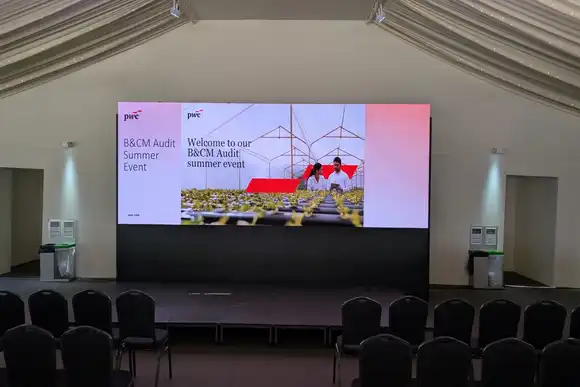
For a 500-person event, a 7m × 4m central LED wall may provide sufficient coverage. In another venue with the same attendance, a central wall supported by relay screens may create far better visibility.
The objective is not to install the largest possible LED wall. It is to make the content clear from the audience positions that actually exist in the venue.
Example LED wall setup for a 500-person London event
Consider a hypothetical 500-person corporate conference in a London hotel ballroom using theatre-style seating, presentation slides, video playback and IMAG.
A central LED wall around 7m × 4m could provide a sensible starting point.
The production team would then review the nearest and furthest audience positions, available stage dimensions, room height and presentation content before confirming the screen. Our guide to designing a stage setup with LED walls looks at the wider stage design in more detail.
Pixel pitch would be selected after assessing the nearest viewing position. If seating extended significantly towards the sides or rear of the ballroom, relay screens could be added rather than simply increasing the dimensions of the main wall.
The technical specification is therefore driven by the room, audience positions and content requirements, not the guest count alone.
How should you choose the final LED wall size?
Before confirming the LED wall, review the screen specification against the complete venue and production plan.
Check:
- Venue width and depth.
- Stage width and depth.
- Available ceiling height.
- Rigging or ground-support requirements.
- Distance to the nearest audience position.
- Distance to the furthest audience position.
- Theatre, classroom or banquet seating.
- Audience sightlines.
- Presentation and data requirements.
- Video playback.
- Live camera and IMAG requirements.
- Branding and scenic design.
- Space available for relay screens.
Working through these requirements gives the production team the information needed to specify the LED wall based on the room and content, rather than relying on guest count alone. When you are comparing suppliers, our checklist of questions to ask an LED wall rental company covers what to confirm before booking.
Choosing the right LED wall for your event
There is no single correct LED wall size for every 500-person event. For many indoor corporate events, a width of 6m to 8m is a practical planning range, with around 7m × 4m worth assessing for some conference, awards and ballroom layouts.
EMS Events can review the venue dimensions, seating plan, presentation content and audience viewing positions before recommending an appropriate LED wall configuration. The screen can also be planned alongside sound, staging, lighting, cameras and wider event production requirements so the technical elements work together rather than being specified in isolation.
FAQs
Is a 5m × 3m LED wall big enough for 500 people?
It can be in the right venue. A 5m × 3m LED wall may suit a compact room with shorter viewing distances, particularly for branding, video and straightforward presentation content. In a deep ballroom or for presentations containing detailed text and data, a larger LED wall or supplementary relay screens may provide better visibility.
Do I need two LED screens for a 500-person event?
Not automatically. A single central LED wall can provide good visibility when the seating layout gives the audience clear sightlines. Additional relay screens become useful when venue width, room depth or wider seating angles prevent some guests from comfortably following the main display. The seating plan should ultimately determine whether supplementary screens are required.