Skip to content
TL;DR
Before booking an LED wall rental company, check the specifications, viewing distances, venue plan, content and playback, technical crew, backup arrangements, and exactly what the quotation includes.
Price and screen dimensions are not enough to compare LED wall rental companies. Before booking, an event organiser should assess five areas: screen specification, venue and installation requirements, content and signal management, crew and live-event support, and pricing and contingency arrangements.
A capable LED wall supplier should be able to explain why a particular display has been specified, how it will work within the venue, how content will reach the screen, who will install and operate it, and what happens if part of the system fails.
Use these 20 questions to compare suppliers before approving your event brief.
Questions about LED wall size and specifications
The LED wall specification should be based on the venue, audience positions and content rather than a screen size selected in isolation. AVIXA’s Display Image Size standard considers display dimensions in relation to viewing positions and what the audience needs to see.
1. What LED wall size do you recommend for our venue, and why?
Ask the supplier to explain how the proposed dimensions relate to the room depth, stage width, audience sightlines and content.
Headcount alone is not enough. Two events with the same number of guests can require different screen configurations because the seating layout and viewing distances may be completely different.
If you are working on a larger brief, our guide to how big an LED wall should be for a 500-person event can help establish an initial planning range before the final venue assessment.
2. What pixel pitch are you recommending?
The recommended pixel pitch should make sense for the nearest audience position and the content being displayed, rather than simply being presented as a premium upgrade.
Pixel pitch is the physical distance between neighbouring LED pixels. A smaller pitch places those pixels closer together and can provide finer image detail at shorter viewing distances. Absen also advises selecting pixel pitch with viewing distance in mind.
A finer pitch than the event requires can increase cost without necessarily improving what the audience experiences.
3. What will the final screen resolution be?
Physical wall dimensions and pixel resolution are different measurements.
The completed LED canvas will have a specific pixel width and height based on the wall configuration and selected LED product. Your content team should receive these dimensions before final presentations, graphics, animations and videos are produced.
This helps avoid resizing or rebuilding content during installation.
4. What aspect ratio will the LED wall use?
A 16:9 display can suit standard presentation and video formats, but modular LED walls do not have to follow a conventional widescreen shape.
Wider stage designs, scenic integrations and bespoke content layouts may require a different canvas. Modular LED systems can be arranged in multiple configurations, including flat and curved builds.
Ask for the final aspect ratio early so your content is designed for the screen rather than adapted on-site.
5. Can you provide the exact LED panel and processor specifications?
A quotation containing only the words “LED wall” leaves important details undefined.
Ask for the:
- Panel manufacturer and model
- Pixel pitch
- Panel dimensions
- Final wall dimensions
- LED processor or control system
- Final screen resolution
This allows you to understand what is actually being supplied and makes competing quotations easier to compare.
Questions about the venue and installation
An LED wall affects staging, power, venue access and the production schedule. The installation method therefore needs to be considered alongside the screen itself.
6. Have you reviewed the venue and seating plan?
An LED wall supplier should base its recommendation on reliable venue information.
Provide the floor plan, stage position, seating configuration, ceiling height and room dimensions where available. If the supplier has not requested venue information or carried out an appropriate site assessment, ask what the proposed specification is based on.
The audience layout should influence the screen just as much as the stage design.
7. Will the LED wall be flown or ground-supported?
Ask how the display will be physically supported and why that approach has been proposed.
Professional rental LED systems can support hanging and stacking configurations, depending on the product. ROE Visual, for example, documents both hanging and stacking options within its rental LED ranges.
Neither approach is automatically better. Venue rigging capacity, ceiling height, available stage footprint, and audience sightlines all affect the decision. Any structural or rigging requirements should be confirmed with the relevant venue and qualified technical professionals.
8. What power does the LED wall require?
Ask for the electrical requirements of the complete proposed LED system, not just an individual panel. The venue team may need information covering power distribution, cable routes, and the position of technical control equipment.
Confirming these requirements during planning reduces the risk of installation delays once the production team is on site.
9. How much installation and de-rig time do you need?
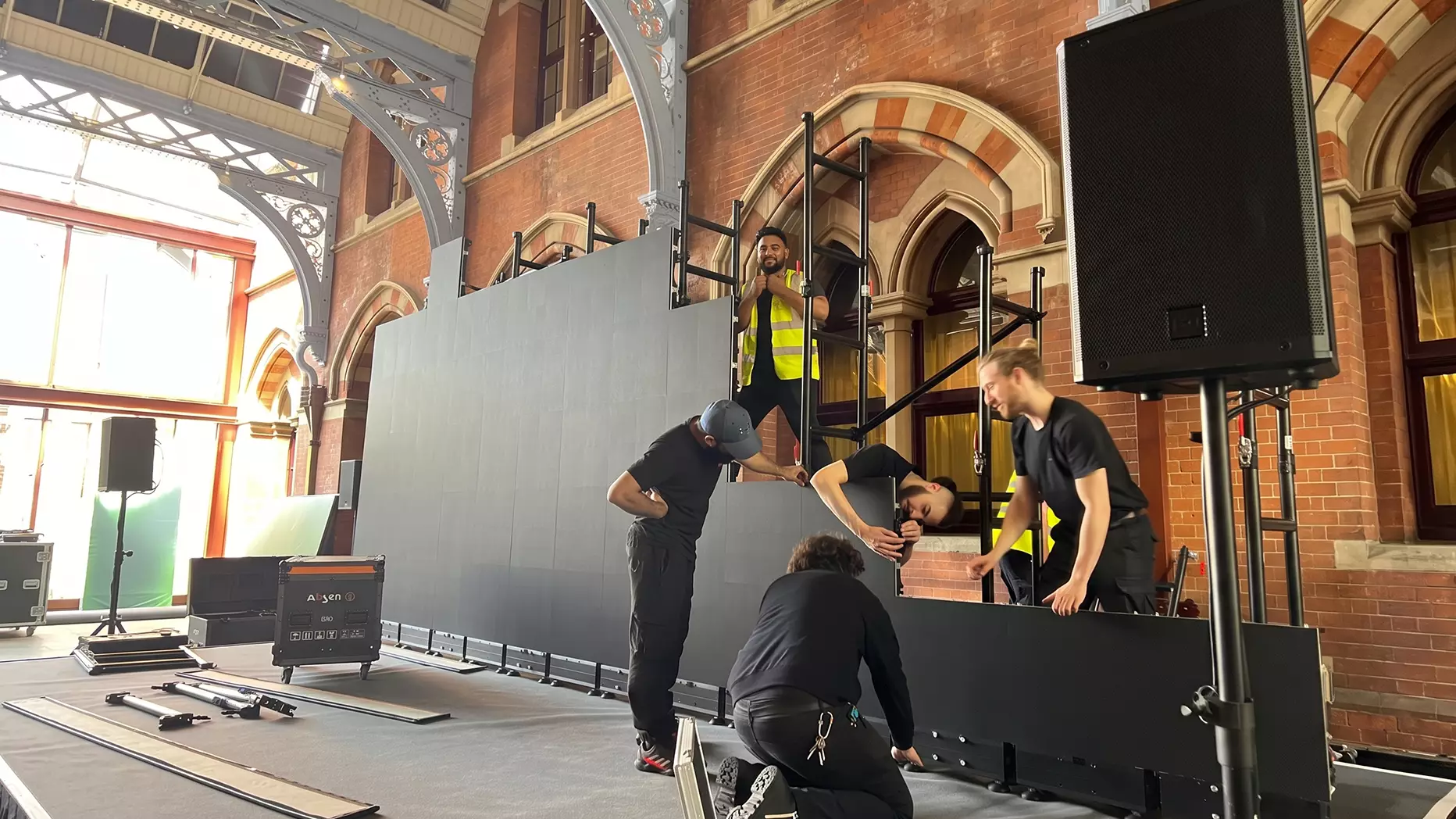
The production schedule should allow enough time for loading, construction, cabling, processor configuration, signal testing, and content checks before the technical rehearsal begins.
Ask the supplier how many hours are required for installation and how much time is needed to remove the system afterwards.
This matters particularly at London venues with restricted loading windows, shared service access, or firm room turnaround times.
10. Will you liaise directly with the venue?
Clarify who is responsible for technical communication. Direct coordination between the LED wall supplier and the venue can cover:
- Loading access
- Rigging
- Power
- Installation times
- De-rig
- Cable routes
- Health and safety documentation
At EMS Events, we manage LED wall delivery, installation, technical setup, live operation and de-rig as part of our event production service.
Questions about content and show delivery
The LED wall is only one part of the visual system. You also need to understand how presentations, videos, graphics, and camera feeds will reach the screen and who will manage them during the event.
11. What format and resolution should our content be supplied in?
Ask for the content specification before designers create final assets.
The supplier should confirm the required dimensions and suitable formats for:
- Presentations
- Video
- Branded graphics
- Holding slides
- Speaker titles
- Animation
For a bespoke LED canvas, content may need to be designed specifically for the final pixel dimensions rather than stretched from a standard presentation format.
12. Who manages presentation playback during the event?
Supplying an LED wall and operating presentation content are different responsibilities.
Establish whether the quotation includes someone to manage slides, videos, and screen cues during the live event, or whether the hire covers the display equipment only. For conferences, product launches, and awards ceremonies, playback often needs to follow the agreed running order and respond to changes as the event progresses.
13. Can the LED wall show presentations and IMAG at the same time?
If your event includes cameras, ask what screen layouts the processing system can support.
IMAG, or image magnification, displays a live camera view of a speaker, panel, or stage activity. Depending on the production design, the LED canvas may need to show presentation content and live camera feeds together using split layouts or picture-in-picture. Confirm those layouts before the content team finalises the screen graphics.
14. Is a technical rehearsal included?
A technical rehearsal allows the complete visual workflow to be tested with the people who will operate it.
Use the rehearsal to check:
- Presentation playback
- Video
- Camera feeds
- Speaker cues
- Screen layouts
- Content changes
- Transitions in the running order
Ask how much rehearsal time is included in the quotation rather than assuming it forms part of the hire.
Questions about crew, reliability, and contingency
When hiring an LED wall, you are also relying on the people and signal infrastructure responsible for keeping the display running throughout the event.
15. Who will install and operate the LED wall?
Ask the supplier to define each crew role.
Establish who will:
- Install the panels
- Configure and test the display
- Manage the processor
- Operate the screen during the event
- Complete the de-rig
Installation does not automatically include live operation, so confirm whether experienced technical support remains on site throughout the event.
16. What backup equipment will be available?
Ask how the supplier has planned for failure of critical components.
Depending on the production, contingency equipment might include spare LED panels or modules, replacement cables, alternative signal paths or backup processing.
Some professional LED processing platforms also support processor redundancy. Brompton Technology, for example, documents backup processor configurations designed to restore the panel network if the primary processor stops outputting a signal.
The appropriate level of contingency will vary according to the event and technical design, which is why it should be discussed rather than assumed.
17. What happens if an LED panel or signal source fails during the event?
Ask the supplier to explain the actual response process.
A useful answer should identify how a fault would be diagnosed, how the signal could be restored and who is responsible for responding during the live event. The objective is not to receive reassurance that failures are rare. It is to understand what happens if one occurs.
18. Is technical support present throughout the live event?
Live events can change after the equipment has been installed.
A revised presentation, an updated video, an additional camera feed or a change to the running order may all require technical action. Having an appropriate technician on site allows those changes to be handled at the control position rather than relying on remote support from a supplier who has already left the venue.
Questions about pricing and the quotation
A useful LED wall quotation should make clear exactly what is included. An unexplained hire figure makes meaningful supplier comparison difficult.
19. What exactly is included in the LED wall hire price?
Ask the supplier to identify the complete scope.
Depending on the event, the quotation may include:
- LED panels
- Processor
- Support structure
- Transport
- Installation
- Technical crew
- Content testing
- Rehearsal time
- Live operation
- De-rig
Two quotations with different totals can describe different production scopes rather than different prices for the same service.
EMS Events, for example, provides an LED wall hire service that covers delivery, setup, live operation and collection, alongside panels and installation support.
20. What could cause the final cost to change?
Ask which changes to the event brief would require a revised quotation.
These might include:
- Larger LED wall dimensions.
- Longer venue access.
- Additional technicians.
- Relay screens.
- Changes to the stage design.
- Additional content work.
- Revised rigging requirements.
- Extended event hours.
Knowing these variables before booking makes it easier to manage the production budget when the brief changes.
LED wall rental checklist before you book
Keep these 20 questions with your supplier shortlist:
- What LED wall size do you recommend for our venue, and why?
- What pixel pitch are you recommending?
- What will the final screen resolution be?
- What aspect ratio will the LED wall use?
- Can you provide the exact LED panel and processor specifications?
- Have you reviewed the venue and seating plan?
- Will the LED wall be flown or ground-supported?
- What power does the LED wall require?
- How much time do you need for installation and de-rigging?
- Will you liaise directly with the venue?
- What format and resolution should our content be supplied in?
- Who manages presentation playback during the event?
- Can the LED wall display presentations and IMAG simultaneously?
- Is a technical rehearsal included?
- Who will install and operate the LED wall?
- What backup equipment will be available?
- What happens if an LED panel or signal source fails during the event?
- Is technical support present throughout the live event?
- What exactly is included in the LED wall hire price?
- What could cause the final cost to change?
What should make you question an LED wall quotation?
Several gaps are worth clarifying before you commit to a supplier.
These might include a size recommendation made without reference to the venue, no pixel pitch or final screen resolution, unclear responsibilities between installation and live operation, missing setup and de-rig timings, no discussion of contingency arrangements, or one hire figure without a clear explanation of what it covers.
None of these automatically means a supplier is unsuitable. Each one is simply a point that should be resolved before the booking is confirmed.
Comparing LED wall rental companies with confidence
A good LED wall rental decision is not based only on screen size or headline price. Before booking, you should understand why the display has been specified, how it fits the venue, how your content will be managed, who operates the system, and what contingency support sits behind the live event.
Our EMS Events production team can review your venue, stage plan, audience layout and content requirements before recommending an LED wall specification.
If you are comparing suppliers for an upcoming event, share the venue plan, stage dimensions, audience layout, and content requirements before requesting the final specification. That gives the production team enough information to design the LED solution around the event rather than simply supplying a screen.