Skip to content

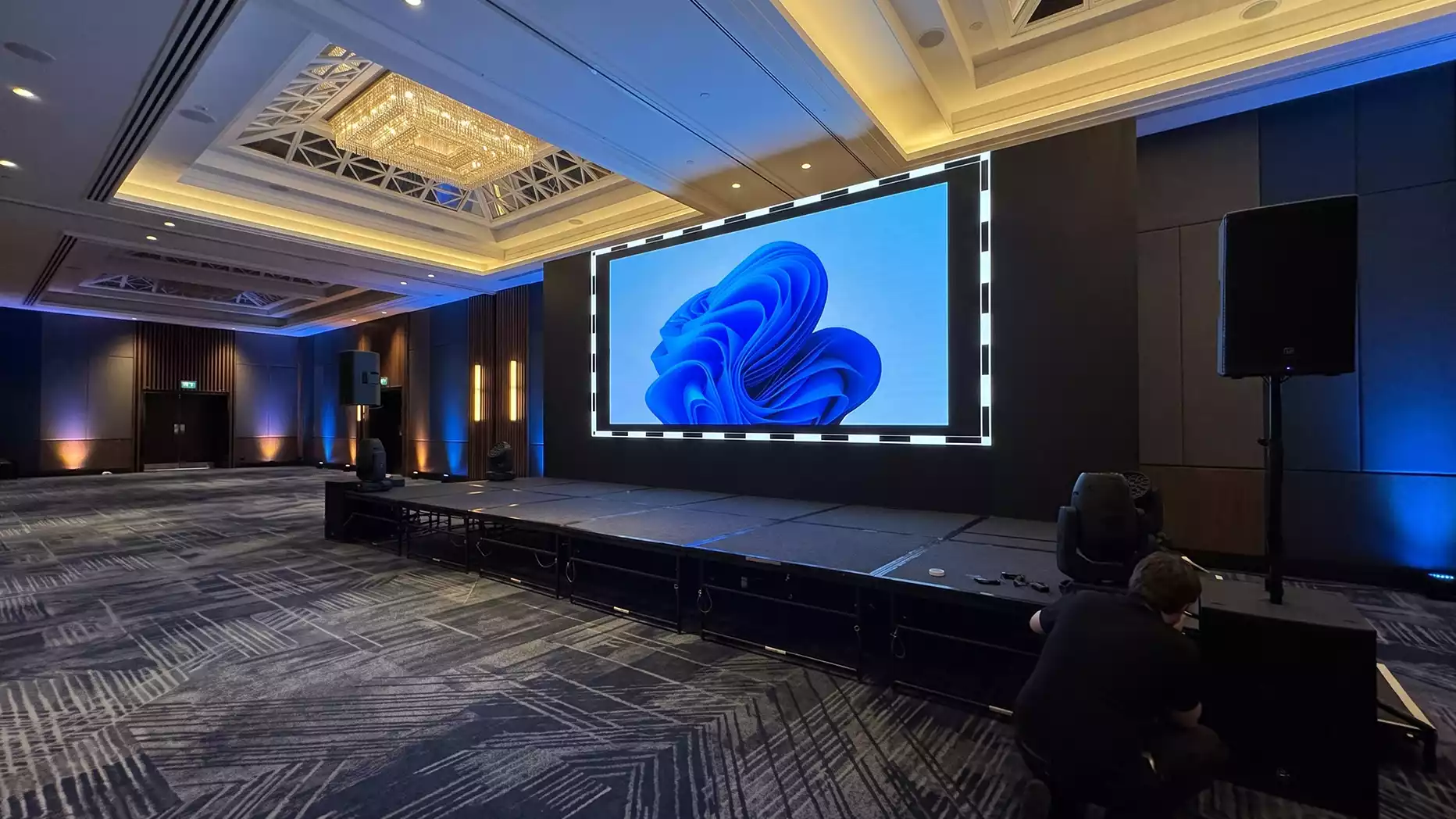
Planning an exhibition at ExCeL London or Olympia means thinking beyond screen size. Your LED wall has to work with the stand design, available power, rigging plan, vehicle access, viewing distance and media content.
For busy autumn exhibitions, it is sensible to start planning LED video wall hire 8 to 12 weeks before the event. This gives your production team time to confirm the display specification, prepare drawings, coordinate venue services and reserve suitable LED inventory.
EMS Events supplies Absen LED video walls with pixel pitches ranging from P2 to P3, including P2, NT2.6 and P3 panels, for exhibitions and corporate events in London. The right setup depends on how visitors will view the display, the dimensions of your stand, and how the screen will be installed.
Why LED wall planning needs to start before the exhibition build
An LED wall affects several parts of an exhibition stand at the same time.
It needs electrical power. A flown display may require venue-approved rigging. A ground-supported wall needs enough floor space and suitable support. The delivery vehicle needs access during the authorised build period. Your creative team also needs the exact screen configuration before producing final content.
Leaving these decisions until build day can lead to layout changes, additional costs or a screen configuration that does not work well with the stand.
The best approach is to plan four areas together:
- LED wall size and pixel pitch.
- Power and technical requirements.
- Rigging or ground-support method.
- Delivery, setup and media preparation.
At large London exhibition venues, each of these may involve separate contractors or booking systems.
Planning LED video wall at Excel London
ExCeL hosts a large number of exhibitions, trade shows and conferences, particularly during the September-to-November exhibition period.
Its 2026 calendar includes events such as Connected Britain on 9–10 September, London Packaging Week on 16–17 September, Brand Licensing Europe on 6–8 October and New Scientist Live on 10–12 October. November also includes several major business and technology exhibitions.
This busy exhibition period makes early AV planning particularly important.
- Power planning at Excel London
Electrical mains at ExCeL can be distributed through floor ducts to exhibition stands, AV equipment and rigging systems. Stand placement therefore needs to be considered alongside the location of available services.
For an LED wall, do not calculate the electrical requirement using screen dimensions alone.
Power consumption varies between LED panel models, brightness levels and configurations. The correct calculation should consider:
- Number and model of LED cabinets.
- Manufacturer-rated average and maximum consumption.
- Video processors and signal equipment.
- Supporting AV equipment.
- Rigging motors where applicable.
- Suitable electrical capacity for the complete installation.
Once the display configuration is confirmed, the technical supplier can determine the expected load and coordinate the requirement with the event’s appointed electrical contractor.
This is much safer than assuming that every 3m × 2m or 5m × 3m LED wall requires the same electrical supply.
- Rigging an LED wall at ExCeL London
A flown LED wall must also be planned around ExCeL’s rigging requirements.
Primary rigging attachments to the venue structure are installed exclusively by the ExCeL rigging team. Approved secondary rigging can then connect to those primary points, subject to the required technical information and approval.
ExCeL advises exhibitors ordering standard rigging services to confirm orders at least 28 days before the event tenancy to access advance rates. Its 2026 rate structure then moves through standard and late booking periods as the tenancy date approaches.
For a flown LED wall, the production team should prepare the proposed screen dimensions, total suspended weight, truss arrangement and individual point loads early.
The venue assesses rigging requirements according to the proposed rigging position and the building’s loading limits. There is no single universal weight-per-square-metre figure that should be applied to every LED installation.
- Ground-supported or flown LED wall?
A flown screen is not automatically better.
Suspending an LED wall can free up usable floor area and give the display more visual presence across a busy exhibition hall. However, it introduces additional engineering, rigging and coordination requirements.
A ground-supported LED wall can be more practical when:
- The screen forms part of the stand backwall.
- The available stand height is limited.
- Overhead rigging is unnecessary.
- The stand design provides enough support space.
- Installation needs to remain relatively straightforward.
The correct method should be agreed during stand design rather than after the LED screen has already been booked.
Delivering LED equipment to ExCeL London
ExCeL requires vehicles needing access to its loading bays to use the ExCeL London Vehicle Booking System.
The system uses Voyage Control technology, and vehicles without a valid booking can be denied access to the loading bay. ExCeL’s guidance also states that available loading times vary according to factors such as vehicle size, event phase and availability.
The booking system normally becomes available close to the event tenancy, so the AV team should have the delivery vehicle and build schedule agreed before the booking window opens.
For a substantial LED installation, the delivery plan should also consider when other parts of the exhibition stand are being constructed.
The screen cannot be planned independently from the stand contractor, lighting team, riggers and electrical provider.
Planning LED video wall at Olympia London
Olympia has its own logistics and rigging processes, so exhibitors should check the relevant show manual rather than assume an ExCeL setup can be transferred directly.
- Rigging at Olympia London
Olympia directs exhibitors to plan rigging requirements with its service partner Outback Rigging Group.
For a flown LED installation, prepare the technical plan early enough for the relevant teams to assess the setup.
Information may include:
- LED wall dimensions
- Total screen weight
- Truss configuration
- Motor requirements
- Suspension positions
- Required electrical services
- Proposed installation sequence
The exact process can differ between exhibitions, so exhibitors should also follow the organiser’s event-specific technical manual.
Do not assume that electrical arrangements or rigging requirements from one Olympia exhibition automatically apply to another.
- Consider the Olympia hall and stand design
Olympia contains several event spaces with different architectural characteristics.
The Grand Hall, for example, is a Grade II listed building dating from 1886.
This makes early coordination particularly important for complex exhibition installations.
Rather than assuming that a flown or ground-supported LED wall will automatically be approved, start with the proposed stand layout and allow the venue’s approved teams to confirm the appropriate installation method.
Delivering LED equipment to Olympia London
Olympia requires vehicles servicing events to pre-book access through Voyage Control.
Vehicles enter the loading and unloading area via Blythe Road from Hammersmith Road. Olympia currently lists a maximum permitted vehicle height of 4.4 metres.
The vehicle type and registration must match the details entered in the booking. Olympia also advises drivers to arrive at their allocated time and complete unloading within the booked slot.
Bookings are normally made available around 30 days before the start of the event, although exhibitors should always check the specific show’s guidance.
This means your logistics planning should happen earlier than the actual Voyage Control booking.
Know which vehicle will carry the LED system, how much equipment is arriving and which crew members will be ready to receive it before the booking window opens.
Choosing the right pixel pitch for an exhibition LED wall
Pixel pitch describes the distance between pixels on an LED panel. A smaller number places the pixels closer together and can provide greater image detail at close viewing distances.
However, the lowest available pixel pitch is not automatically the best choice.
The specification should reflect how the display will actually be viewed.
EMS Events currently supplies Absen LED panels ranging from P2 to P3 pixel pitch, including:
- P2 LED panels
P2 panels can work well where visitors will be relatively close to the screen and detailed visual content needs greater pixel density.
They may be suitable for exhibition environments where the screen is positioned close to visitor traffic or where presentations and graphics contain finer detail.
- Absen NT2.6 LED panels
P2.6 provides a useful middle ground for many indoor event applications.
It can deliver detailed exhibition graphics and video while allowing the display to scale into a larger modular wall.
- P3 LED panels
P3 panels can work effectively for larger exhibition screens where the audience is positioned further from the display.
They can be used for brand graphics, video, motion content and larger-format exhibition backdrops.
The right choice depends on much more than the pitch number. Screen dimensions, viewing distance, content type, stand layout and budget should all be considered.
EMS Events’ modular Absen system also allows wall dimensions and layouts to be adjusted to suit the event space.
Screen size matters as much as pixel pitch
A small high-resolution LED display can still fail to make an impact if it appears undersized within a large stand.
Likewise, an oversized screen can dominate the available space and leave too little room for products, meeting areas or visitor movement.
Start with three questions:
- How wide and high is the available display area?
- Where will the nearest visitors normally stand?
- What information needs to appear on the screen?
These answers help determine the screen dimensions before the final pixel pitch is selected.
A technical AV supplier can then calculate the cabinet arrangement needed to produce the required wall.
Prepare content for the actual LED wall resolution
One of the most common LED content mistakes is designing everything at 1920 × 1080 and assuming the wall will behave like a standard 16:9 television.
LED walls are modular.
Their native pixel dimensions depend on the specific cabinet model and the number of panels used horizontally and vertically.
A wide exhibition backdrop may therefore have a very different aspect ratio from a standard HD screen.
Ask the LED supplier for the final pixel map or canvas dimensions as soon as the screen configuration is approved.
Your content team can then produce files for the actual display rather than stretching or cropping standard presentation content.
Check these before final media delivery
Confirm:
- Exact pixel canvas dimensions.
- Aspect ratio.
- Accepted media formats.
- Playback frame rate.
- Presentation or playback system.
- Safe areas for text and logos.
- Final content delivery deadline.
- Backup playback files.
Content should also be tested before visitors enter the exhibition.
A screen can be technically perfect but still perform poorly if important text is too small, logos fall outside the visible area, or video files do not match the required format.
ExCeL London vs Olympia London: LED wall planning
| Planning Area | ExCeL London | Olympia London |
| Vehicle access | ExCeL Vehicle Booking System using Voyage Control. | Voyage Control booking required. |
| Loading access | Venue loading bays according to booked slot. | Blythe Road via Hammersmith Road. |
| Vehicle booking | Required for vehicles accessing loading bays. | Required for vehicles servicing events. |
| Primary rigging | Managed exclusively by ExCeL’s rigging team. | Plan through Outback Rigging Group. |
| Power | Electrical services coordinated through venue/event contractors. | Follow appointed event electrical services and show manual. |
| Screen support | Ground-supported or approved flown solution. | Ground-supported or approved flown solution. |
| Key planning point | Coordinate rigging, power and loading early. | Confirm event-specific rigging and logistics requirements. |
| Event guidance | Check organiser manual and ExCeL services information. | Check organiser manual and Olympia exhibitor information. |
Both venues can support major LED installations, but their operational processes are not identical.
Treat each exhibition as a new technical project.
Autumn 2026 LED wall booking timeline
London’s autumn exhibition calendar becomes busy quickly.
A practical timeline for a larger exhibition LED wall is:
- 12 weeks before the exhibition
Confirm the AV supplier.
Agree the approximate LED wall dimensions, preferred position and installation method. Reserve suitable LED inventory, especially if several large London exhibitions fall within the same period.
- 8 weeks before
Lock the technical specification.
Confirm the proposed rigging or ground-support arrangement and coordinate electrical requirements with the stand contractor and relevant venue services.
For more complex flown walls, technical drawings should already be progressing.
- 4 weeks before
Finalise the display configuration and give the creative team the exact LED canvas dimensions.
Confirm crew requirements, build sequence, playback equipment and signal routes.
This is also the point to check when the venue vehicle-booking system becomes available.
- Final Weeks
Book the correct delivery slot as soon as the relevant system opens.
Complete final content checks and ensure the stand contractor, AV team, venue services and other technical suppliers are working from the same build schedule.
How EMS Events supports exhibition LED video walls
EMS Events provides LED video wall for exhibitions, conferences, product launches, awards and corporate events across London.
Its current LED inventory includes Absen P2, NT2.6 and P3 panels, allowing screens to be configured in different dimensions according to the venue, event design and viewing requirements. EMS also supplies stands and rigging solutions and provides skilled technicians for setup and installation.
The advantage of working with one technical production team is coordination.
An exhibition display needs to work alongside the sound system, lighting, staging, truss, content and overall stand layout. EMS supplies a wider range of audio-visual, lighting, staging and truss equipment alongside its LED wall systems, which can reduce the number of separate technical suppliers involved in the project.
For ExCeL or Olympia, the team can help determine the screen size, pixel pitch and installation requirements before the venue-specific services are confirmed.
Planning an Exhibition at ExCeL or Olympia?
A successful LED wall starts before the first panel reaches the venue.
Get the screen size, pixel pitch, support method, power requirement, content resolution and delivery plan agreed early, and the installation becomes far easier to manage when build day arrives.
EMS Events supplies Absen LED video walls for exhibitions and corporate events across London, with P2, NT2.6 and P3 panels, technical setup and on-site support.
Contact EMS Events at 0207 820 9000 to discuss LED video wall requirements for your next exhibition.
FAQs
How far in advance should I book LED video wall for ExCeL or Olympia?
For busy autumn exhibitions, start planning around 8 to 12 weeks before the show. Larger walls and flown installations usually require more technical coordination than smaller ground-supported displays. Early planning also gives you more time to reserve suitable LED inventory and prepare venue documentation.
What pixel pitch is best for an exhibition LED wall?
It depends on the screen size and nearest viewing distance. EMS Events supplies Absen P2, NT2.6 and P3 LED panels. P2 provides greater pixel density for closer viewing, while P2.6 and P3 can work well across larger exhibition applications. The complete stand layout should determine the final specification.
Can my AV supplier rig an LED wall directly from ExCeL’s building structure?
No. Primary rigging attachments to the ExCeL building structure are installed exclusively by ExCeL’s rigging team. Secondary rigging may then be connected to approved primary points when the correct technical information and approvals are in place.
Who handles rigging at Olympia London?
Olympia directs exhibitors to plan rigging services with its venue service partner, Outback Rigging Group. Exhibitors should also follow the technical requirements in their individual show’s exhibitor manual.
How much power does an exhibition LED video wall need?
There is no single figure for every wall. Power depends on the LED panel model, number of cabinets, operating brightness and associated processing equipment. The AV supplier should calculate the requirement from manufacturer specifications and coordinate the correct electrical supply with the event’s appointed contractor.
Do delivery vehicles need to be booked at ExCeL London?
Yes. Vehicles requiring access to ExCeL’s loading bays need to be pre-booked through the ExCeL London Vehicle Booking System. Available slots depend on the event, vehicle type and availability.
Do delivery vehicles need a booking at Olympia London?
Yes. Vehicles servicing an Olympia event must pre-book access through Voyage Control. Olympia advises drivers to arrive at their allocated time and complete unloading within the booked slot.
Should exhibition LED content be designed in 16:9?
Not automatically. LED wall resolution depends on the selected panel model and cabinet arrangement. Ask your AV supplier for the final pixel dimensions before creating the finished graphics, animation or video.