Skip to content

TL;DR
Before choosing the lowest price, check the pixel pitch, final resolution, crew hours, de-rig time, backup equipment, London logistics, VAT and change-order terms. A cheap quote can be fine if it is honest dry hire, but it becomes risky when key items are missing. Use the quote to compare scope first, then compare price.
If you have requested LED video wall hire quotes from three suppliers and they’ve come back at wildly different numbers for what looks like the same brief, the explanation is almost always scope, not pricing. Two quotes for the same 5m x 3m wall can be more than double apart, and both can be honest. One is dry hire, with the organiser supplying crew and operation; the other is a fully managed package with technicians, rehearsal time, de-rig, and backup equipment included.
This guide covers the specific red flags to check line by line when the quotes don’t match, grouped into specification, crew, logistics and commercial terms.
Why LED wall quotes vary so much
Quote variation comes down to scope more than supplier markup. Dry hire quotes supply equipment only; fully managed quotes include delivery, crew, rehearsal, technical operation on the day and de-rig. Our guide to AV hire vs full event production explains where that line sits. The gap between the two for the same screen size can run 2 to 3 times. A quote that looks half the price of another is often half the scope, with the missing items reappearing as change-order invoices on the day or absorbed into the organiser’s own labour cost. Our LED wall cost guide covers the full pricing bands and what’s included in each tier. For reference, it puts a 5m x 3m screen at £1,200 to £2,000 a day before crew, rehearsal and de-rig are added.
The red flags below are the specific things to check so the comparison between quotes is like-for-like.
Red flags in the specification
Specification is where the biggest hidden gaps live. A quote that reads ‘LED wall supplied’ and nothing else is not a specification; it’s a line item hiding four or five decisions.
1. No pixel pitch stated
Dimensions given in metres but no mention of P2.6, P2.9, P3.9 or similar. What it likely means: the supplier may be changing the pitch to match the price point rather than specifying it against your venue. A P3.9 wall at a boardroom-scale event looks pixelated to the front row; a P1.9 wall at a large-stage event is over-specified, and you pay for pixel density the back rows can’t see. Pitch moves the price a lot: our cost guide puts a 3m x 2m screen at £1,000 to £2,500 at P2.6, against £600 to £1,800 at P4.0 to P6.0.
For genuinely coarse-pitch outdoor hire, the pitch range is less critical and may be omitted from a short-form quote. Choosing the right LED wall pixel pitch matters because the wrong pitch can make a close-view screen look pixelated or push the quote higher than it needs to be.
2. No final resolution supplied
Physical dimensions (5m x 3m) with no pixel resolution (e.g. 1,920 x 1,152 at P2.6). What it likely means: your content team doesn’t have what they need to prepare presentations and video at the right aspect ratio and resolution. On the day, slides turn out stretched, pillarboxed or soft because they were prepared for a different canvas. Resolution follows directly from the wall size and pitch, so a supplier may expect you to calculate it. Ask for it on the quote regardless.
3. Single ‘LED wall’ or ‘AV package’ line item with no breakdown
One price for an unfamiliar category, with no itemisation of panels, processor, support structure, crew, or logistics. What it likely means: scope is hidden, variation triggers are undefined, and the headline figure cannot be compared to a quote that breaks the same scope into visible lines. A very small event with a single-item scope (one small screen, delivered and installed) might reasonably land on one line, but anything larger should itemise.
4. No panel manufacturer or processor named
‘LED panels’ with no reference to Absen, ROE Visual, Unilumin or similar, and no mention of the processor driving them. What it likely means: the supplier may be sourcing panels from mixed stock, which affects consistency and signal path quality. Named manufacturers and a named processor (such as Brompton or NovaStar) mean the supplier has committed to a specific product. Some suppliers deliberately keep the quote brand-neutral and will name specifics upon request. Asking for the specification should get a straight answer either way.
Red flags in labour and crew
Crew is where quotes most commonly diverge because event days never run exactly as planned, and the hours required to deliver the show can quietly grow.
5. No crew count or hours stated
‘Crew included’ or ‘technicians on site’ with no numbers against roles or hours. What it likely means: either the crew is under-counted for the scope (two technicians for a build that genuinely needs four), or overtime is a variation waiting to be invoiced after the event overruns.
Our cost guide puts an on-site technical team at £100 to £500 per day, depending on roles and hours. Each extra technician adds to that across install, show day and de-rig, so check the crew count against the scope rather than the headline total. Some suppliers include crew as a round figure for standard-scope events and will itemise on request.
6. No de-rig time or cost mentioned
Install and show-day coverage; nothing about pack-down. What it likely means: de-rig is happening on a night shift or the following morning and is either absorbed into crew hours (sometimes fine), added as a separate night-rate invoice (usually not disclosed upfront), or expected from the organiser’s own team (rare, but it happens).
For very small or short events, de-rig might reasonably be included in the main crew booking. For anything over half a day, it should be explicit.
7. No named production contact or on-site technician
Production support or technical crew with no named individual or role structure. What it likely means: the person running your show on the day may not be the person who scoped it, and the handover between sales, project management and crew is where first-time organisers get lost. For dry-hire scopes, this is deliberate because no production support is included. For anything above dry hire, a named production contact should be in the quote.
Red flags in logistics and venue
London venue logistics add a real cost that the supplier passes through, whether the quote shows them or not. If they’re not itemised, they often reappear as ‘additional charges’ after the event.
8. No ULEZ, Congestion Charge or London logistics costs itemised
A flat delivery figure for a Central London venue with no breakdown. What it likely means: either the supplier has absorbed the Congestion Charge, parking, loading-bay and timed-delivery costs into the delivery price (fine, if the quote is competitive overall) or they’re expecting to invoice them afterwards as an uplift. The congestion charge alone has been £18 per vehicle per day since 2 January 2026, so a multi-vehicle install over two days adds up. ULEZ now covers every London borough, but it only charges vehicles that don’t meet the emissions standard (£12.50 a day), so a supplier running a compliant fleet may genuinely have nothing to list. For venues inside the Congestion Charge zone, logistics costs should be visible.
9. No venue liaison or site visit mentioned
A quote built from the event brief alone, with no reference to a conversation with the venue’s technical team. What it likely means: scope is based on assumptions about power, rigging and load-in. If any assumption proves incorrect, the rework will be charged as a variation.
For small events in standard venues the supplier knows well, a formal site visit may not be needed. For anything bespoke or in an unfamiliar venue, it should be in the scope.
10. No installation and de-rig timing against venue access windows
Hours quoted for install and de-rig without reference to when the venue allows the trucks in or out. What it likely means: the supplier hasn’t checked, which means timed-delivery charges, overnight access premiums, or storage costs may be added after the booking.
Red flags in commercial terms
Commercial terms are where quotes diverge most often on paper and most expensively in practice.
11. Ambiguous or missing VAT presentation
What you would see: a figure with no ‘ex VAT’ or ‘inc VAT’ label. What it likely means: a £5,000 quote might be £5,000 or £6,000 depending on which the supplier assumed. Two quotes with the same headline number can be 20% apart. UK corporate convention is ex VAT, so unlabelled quotes default to ex.
12. No change-order process or variation triggers stated
No mention of what triggers a re-quote or how on-the-day changes are priced. What it likely means: variations will be invoiced after the event at whatever rate the supplier chooses, with no agreed authorisation step. The honest counter: for very simple, short-form bookings, the change-order process may sit in the terms and conditions rather than the quote. Before signing, check the key AV contract questions that define variation charges, change approvals and on-the-day support.
13. No backup equipment or contingency referenced
Panels, processor and cabling as single units with no mention of spare panels, backup processor or redundant signal path. What it likely means: if a panel fails on the day, the show has a failed section of the wall for however long it takes to source a replacement. For very small walls, carrying full backup may be disproportionate. For anything approaching conference scale, backup should be included in the price, not charged on the day.
When a cheap quote is actually fine
Not every low quote is a red flag. The low quote is often genuinely competitive when the scope is honest dry hire with no production support, the venue has a strong in-house AV team already covering the show-day operation, the event is small and simple enough that one line item makes sense, or the supplier is genuinely leaner than the market because their overhead structure is smaller. In those cases, the lowest quote with the correct scope is the right call. The failure mode is not choosing the cheap quote. It’s choosing the cheap quote assuming it includes what the higher quote covers.
When an expensive quote is actually right
Not every high quote is overpriced. The high quote is often the most honest when every line is itemised and visible, pixel pitch is justified against the specific venue and audience distance, crew is named with hours against roles, rehearsal time is included, backup processor and spare panels are on the truck as standard, de-rig is on the manifest, London logistics are listed as separate line items, and VAT is clearly presented.
In those cases, the high quote reflects a complete scope delivered properly rather than a markup. A low quote in the same cluster is almost certainly missing something that the high quote shows.
You can also use these questions to ask an LED wall rental company to check the supplier before you compare the final price.
Always compare LED quotes on equal terms
The organiser’s job when comparing LED wall quotes is to make scope visible so the headline figures become comparable. Scope, not price, is the honest frame. At EMS Events we itemise our quotations so every line is visible from the outset, which makes the comparison clear in either direction.
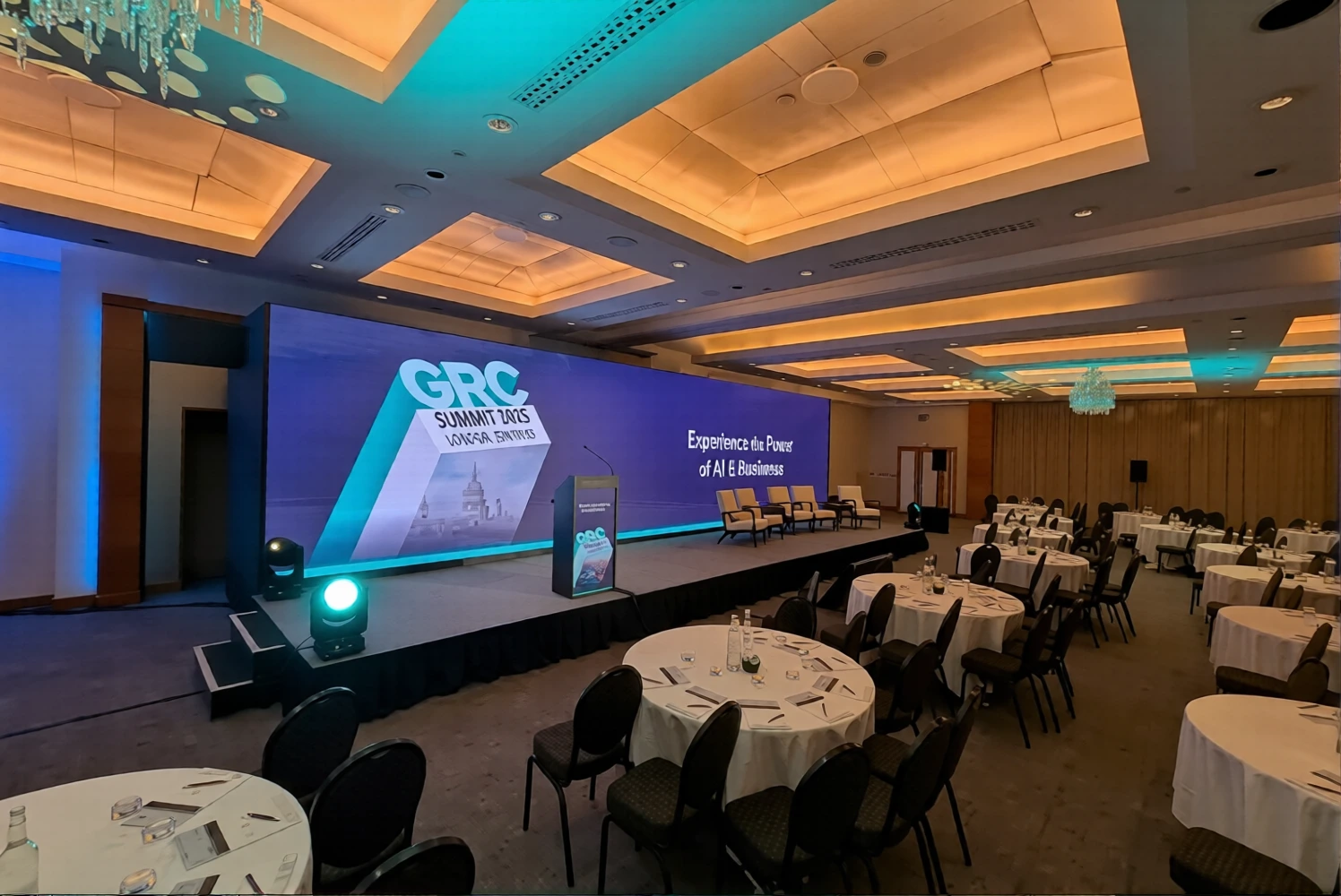
To see what a fully managed LED scope looks like in practice, read our MetricStream GRC Summit case study, where we delivered multi-space AV production with a 12-metre LED video wall at the Royal Garden Hotel.
If you have quotes from other suppliers you would like a sense-check on, send them to our team and we can review them line by line against what we would supply for the same brief. For the full scope of services, see our LED video wall hire services before comparing quote details.
FAQs
Why is one LED wall quote half the price of another for the same event?
Usually dry hire vs fully-managed scope. Dry hire supplies equipment only; fully managed includes delivery, crew, rehearsal, technical operation, and de-rig. The 2- to 3-times price gap reflects a scope difference, not a supplier markup. Asking each supplier to itemise crew, de-rig, rehearsal and operator time usually explains the gap in one line.
Should I always pick the cheapest LED wall quote?
Only if you’ve verified the scope matches what the event actually needs. The cheapest quote with correct scope is the right call every time; the cheapest quote with missing items becomes the most expensive on the day once variations and overtime are invoiced. Compare scope line by line before comparing headline figures.
What should an LED wall quote itemise at minimum?
Panels and pixel pitch, LED processor model, support structure (ground-supported or flown), delivery and setup, crew count and hours against named role, de-rig, backup equipment reference, London logistics (ULEZ and Congestion Charge where applicable), and clear VAT presentation. Anything missing from that list is a line item hidden somewhere else or absorbed into on-the-day invoicing.